There is a tendency in maritime technology marketing to treat AIS as if it were an infinitely expandable layer of ocean intelligence—an open system that can simply absorb more devices, more data points, and more “smart” applications without consequence. Fishing net buoys are one of the latest beneficiaries of this assumption. They are marketed as a natural evolution of offshore operations: attach a transmitter to a net, visualize it on a chart, and reduce gear loss. Clean, efficient, almost obvious.
But AIS was never designed to be a general-purpose tracking network for mobile industrial objects. And the more AIS fishing buoys proliferate, the harder it becomes to ignore the regulatory and systemic tension underneath that narrative.
At the center of this tension sits ITU-R M.2135, a framework intended to define how autonomous maritime radio devices should behave within the 156–162.05 MHz AIS band. In theory, it exists to ensure that non-vessel AIS transmitters remain compatible with the original purpose of AIS: collision avoidance and maritime safety coordination. In practice, however, it functions more like a loose boundary condition than a strictly enforced rule set, especially when devices are deployed outside tightly monitored commercial shipping contexts.
The problem is not that AIS fishing buoys are inherently illegal or non-compliant. The problem is that the regulatory ecosystem around them was never built for their current scale or behavior.
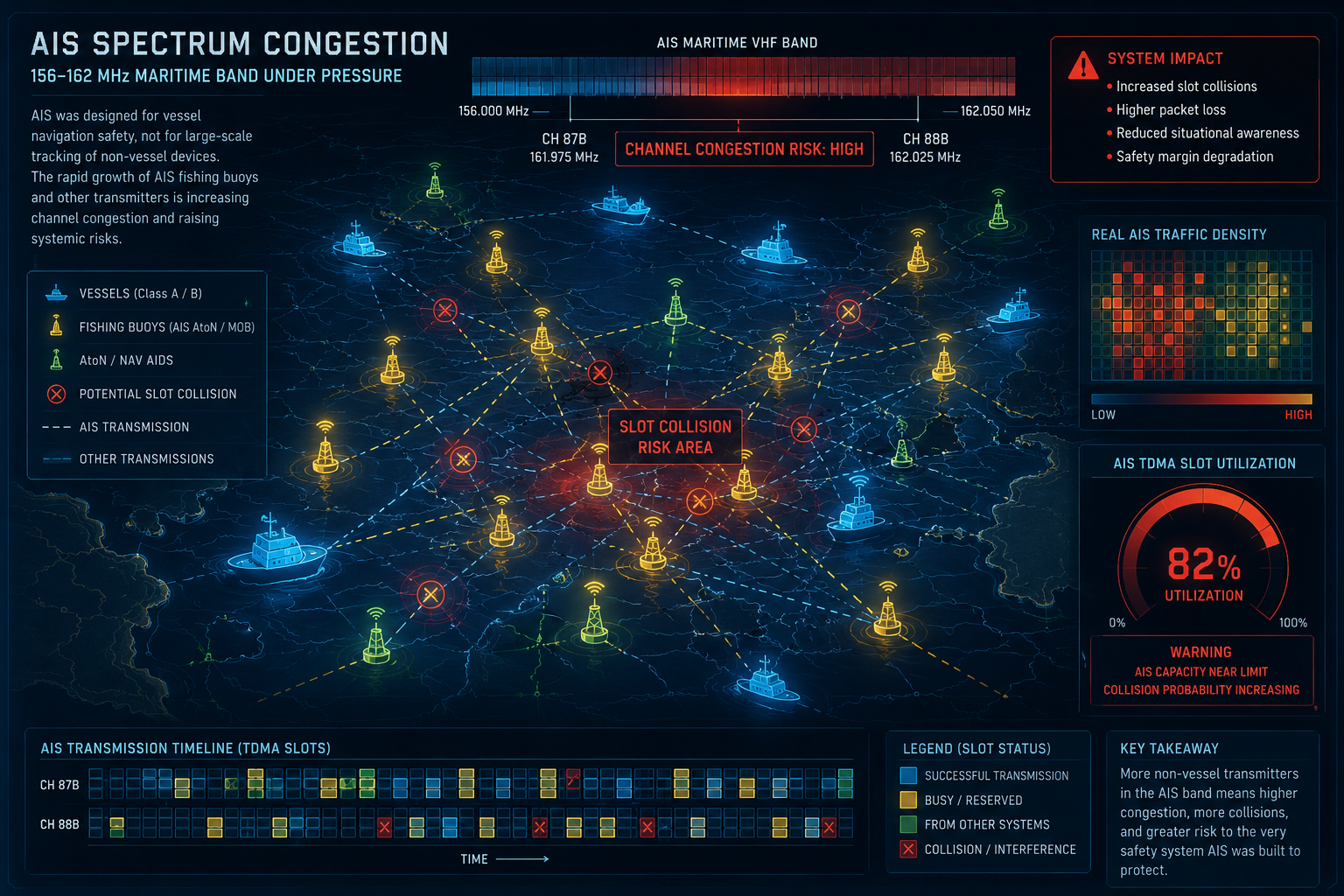
AIS is a self-organizing time-division system (SOTDMA/TDMA-based depending on class), designed around predictable vessel density and transmission behavior. It assumes that most transmitters are large, power-stable, and spatially distributed in ways that loosely correlate with navigational traffic. Fishing buoys break several of those assumptions at once. They are small, numerous, intermittently submerged, solar-powered, and often deployed in clusters that bear little resemblance to vessel traffic logic.
From a spectrum management perspective, this matters more than most offshore users realize. AIS is not just “a channel.” It is a tightly choreographed RF environment where timing collisions, slot reuse, and transmission probability are carefully balanced. When additional non-vessel devices enter the system at scale, even if individually compliant, they increase aggregate slot contention. And AIS does not degrade gracefully under uncontrolled growth—it becomes noisy, less deterministic, and harder to interpret under stress conditions, which is exactly when it is most needed.
This is where regulatory ambiguity begins to surface.
In the United States, the FCC regulates maritime AIS transmissions under Part 80 rules, with strict expectations around device certification, emission behavior, and use case legitimacy. AIS was originally authorized for maritime safety communications between vessels and shore stations—not as a generalized IoT layer for industrial asset tracking. While AIS-AtoN and certain autonomous maritime devices are permitted, fishing gear trackers sit in a less clearly defined category, especially when deployed at scale and outside traditional navigational aid frameworks.
Internationally, ITU recommendations such as M.2135 attempt to harmonize this space, but they are recommendations—not enforcement mechanisms. That distinction is critical. It means that compliance often depends on interpretation by manufacturers, flag states, and sometimes even individual fleet operators rather than a single global enforcement authority.
The result is a quiet gray zone: AIS fishing buoys are widely deployed, increasingly normalized, but still structurally ambiguous in terms of how they fit into the original legal and technical intent of AIS.
There is also a more uncomfortable operational question that rarely gets discussed in marketing narratives: what happens to AIS reliability when thousands of non-vessel transmitters begin to behave like a parallel layer of maritime infrastructure?
AIS was never intended to be a high-density asset tracking network. Its core value depends on predictability. Vessels transmit at defined intervals based on speed and maneuvering state. That logic breaks down when you introduce large populations of low-power, semi-static devices whose transmission behavior is governed more by battery management and exposure conditions than navigational dynamics.
Even if each fishing buoy is technically compliant in isolation, compliance does not guarantee system stability. It only guarantees that the device does not individually violate spectral rules. The systemic effect—how all devices behave together under congestion—is not fully captured by device-level certification frameworks.
This gap between device compliance and system behavior is where many AIS expansion applications quietly sit today.
It is also where commercial pressure begins to outpace regulatory clarity. Offshore fishing is economically incentivized to reduce gear loss and improve recovery efficiency. A lost net can represent significant operational cost, and in large-scale fisheries, even small efficiency gains translate into meaningful financial impact. AIS buoys directly address that pain point, which explains their rapid adoption.
But adoption does not resolve the underlying question of spectrum stewardship.
AIS is a shared safety infrastructure. Every additional use case introduced into it effectively competes with its original purpose: preventing collisions and maintaining navigational awareness under degraded conditions. The more it is used for asset tracking, the more it shifts from a safety-critical system toward a general-purpose maritime telemetry network—without ever formally being reclassified as such.
This is the quiet tension behind modern AIS fishing buoy deployment: not whether the technology works, but whether the system it relies on was ever meant to carry this kind of load.
Products like Solar AIS BUOYS 888 sit directly inside this evolving contradiction. On one hand, they represent a practical engineering response to real offshore problems—gear visibility, retrieval efficiency, operational safety. On the other hand, they depend on an AIS ecosystem whose long-term scalability under non-vessel device proliferation has not been fully resolved at the regulatory level.
In practice, most fleets operate in good faith, and most devices are designed to remain within accepted technical parameters: limited transmission power, controlled duty cycles, solar-assisted energy management, and marine-grade enclosure design. But good faith compliance does not eliminate structural uncertainty in how these devices accumulate across dense fishing regions.
And that accumulation is what regulators will eventually have to confront more directly.
Because the real question is not whether AIS fishing buoys should exist—they already do, and they clearly solve real operational problems. The question is whether AIS, as a shared maritime safety system, can continue to expand its functional scope indefinitely without redefining its governance model.
At some point, spectrum is not just a technical constraint. It becomes a policy decision about what kind of ocean visibility infrastructure is considered acceptable inside a safety-critical communication layer.
And that decision, for now, remains unresolved.