Why Solar-Powered AIS Buoys Are Becoming Essential for Modern Aquaculture Expansion
Global aquaculture production is projected to reach 120 million metric tons by 2030, driven by rising protein demand and the plateau of wild-catch fisheries. For aquafarm operators managing offshore net pens and longline mussel farms, this growth creates a logistical challenge: how do you monitor hundreds of perimeter nets across vast coastal areas without sending crews out daily? The answer increasingly lies in solar-powered AIS buoys.
The Hidden Cost of Traditional Net Monitoring
Before autonomous tracking technology, aquaculture farms relied on manual vessel patrols to check net integrity and position. For a mid-size salmon farm operating 50 net pens, this meant:
- Daily fuel costs of $200–$400 per patrol vessel
- Labor costs for 2–3 crew members per shift
- Weather-dependent windows — storms delay checks and increase escape risks
- No real-time data on net drift or unauthorized vessel proximity
These operational costs erode margins in an industry where feed and certification already consume 70% of operating budgets.
How Solar AIS Fishing Net Trackers Change the Economics
Modern solar-powered AIS fishing net tracking buoys combine three technologies into one maintenance-free package:
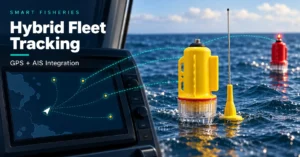
- AIS Transponder: Broadcasts the net’s exact GPS position every 2–3 minutes to any vessel or shore station within 12 nautical miles.
- Photovoltaic Panel: Continuously recharges the internal battery during daylight, eliminating replacement cycles.
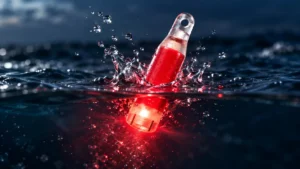
- Flashing Strobe: Provides nighttime visual identification with customizable colors (green, red, blue, white) to mark different farm zones.
The result is a set-and-forget deployment. Once anchored, the buoy requires zero human intervention for months or even years, depending on solar exposure.
Real-World Application: Offshore Fish Farms
Consider a sea bass farm in the Mediterranean or a grouper operation in Southeast Asia. By deploying AIS buoys at each corner of a net pen array, the farm manager receives continuous position data on a single dashboard. If a storm shifts a net pen by even 10 meters, the marine GPS tracking device inside the buoy flags the movement immediately, allowing corrective action before fish escapes or predator intrusion occurs.
Spec Sheet: What Aquaculture Operators Need
Not all solar buoys perform equally in humid, high-salinity environments. Sikes solar AIS buoy models are engineered specifically for permanent marine deployment:
- 666 Series: 3 high-efficiency solar panels, 12W output, 12 NM range, IPX8 waterproofing
- 888 Series: 5 solar panels for enhanced charging in low-light conditions (cloudy climates, higher latitudes)
- 4000mAh Backup Battery: Maintains operation through 3–5 consecutive overcast days without solar input
- Adjustable Strobe: 4 brightness levels and multiple flash patterns for different regulatory zones
From Cost Center to Data Asset
Beyond immediate labor savings, the position data generated by marine GPS locators creates long-term value. Farm operators can analyze current patterns, identify high-risk drift zones and optimize net pen placement for the next growing season. For distributors selling into the aquaculture supply chain, this data narrative is a powerful sales tool.
Conclusion
As aquaculture moves further offshore to access cleaner water and larger volumes, manual monitoring becomes economically impossible. Solar-powered AIS buoys are not a luxury — they are infrastructure.
Looking for solar AIS buoy wholesale pricing? Request a distributor quote from Sikes with MOQ and OEM options for your regional aquaculture market.