Underwater Fishing Light Color Guide: Matching Wavelength to Target Species and Depth
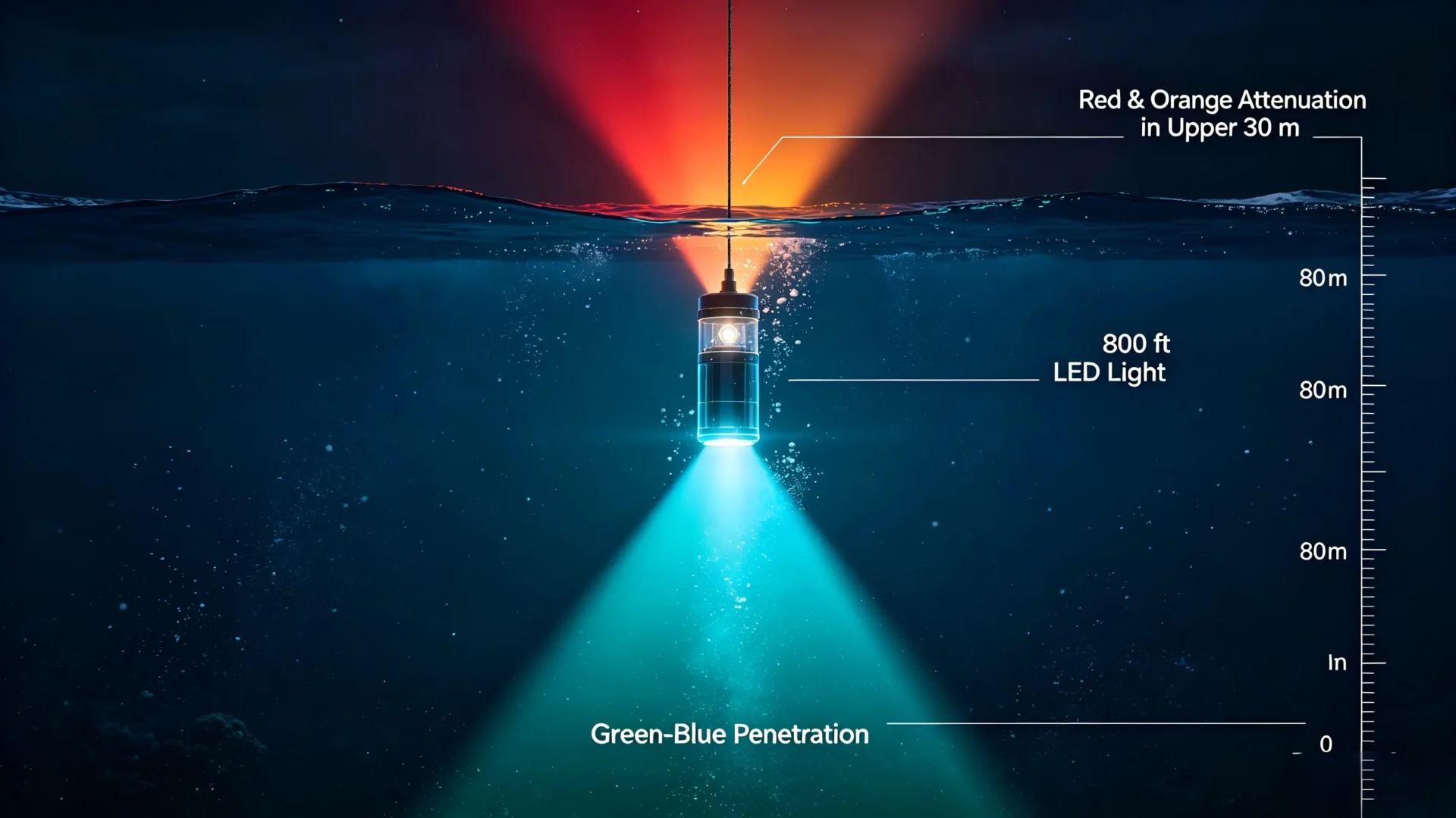
The short answer: below 150 m, only blue and green light physically arrive at your bait in any useful quantity. Which of the two wins depends on your depth band, water clarity, and target species – and the physics behind that choice is the same physics that decides how far your light is visible at all.
Pick the wrong color and your LED is not just dimmer – it is, for all practical purposes, off. A red light at 300 m produces a glowing sphere a few meters wide in absolute darkness, invisible to anything beyond it. A green or blue light at the same depth can be seen from tens of meters away. This guide explains the seawater optics behind that difference, compares blue vs. green head-to-head, and matches both to the actual depth bands where tilefish, grouper, snapper and swordfish live.
1. The Physics: How Seawater Eats Light
Water is a selective filter. Pure seawater absorbs long wavelengths (red, orange) with extraordinary efficiency while letting a narrow window of short-to-mid wavelengths through:
- Red & infrared (~620-750 nm): absorbed within the first 10-20 m. This is why a red shirt looks black a few meters down – the red light never made the round trip.
- Orange & yellow (~570-620 nm): effectively gone by 50-80 m.
- Blue (~450-500 nm): the deepest-penetrating band in clear open-ocean water. Attenuation reaches its minimum around 465-480 nm.
- Green (~500-560 nm): the deepest-penetrating band in coastal and turbid water, where suspended particles scatter blue more strongly. The attenuation minimum shifts to roughly 525-550 nm.
- Violet/UV (<400 nm): scattered and absorbed near the source underwater.
Optical oceanographers classify water into Jerlov types: clear “oceanic” water (Type I), where blue wins, through increasingly turbid “coastal” types (II-III and beyond), where the window shifts steadily toward green. In practice:
- Offshore Atlantic canyons, Gulf Stream edges, deep tropical water -> blue-biased window.
- Gulf of Mexico shelf, estuary outflows, any water with sediment or phytoplankton -> green-biased window.
Intensity follows exponential decay – I = I0·e(-c·z) – meaning every extra meter costs a fixed percentage of your light. Doubling your LED power does not double your visible range; it only buys you a fraction of it. Wavelength selection is a force multiplier that battery capacity can never replace.
2. Blue vs. Green: The Head-to-Head
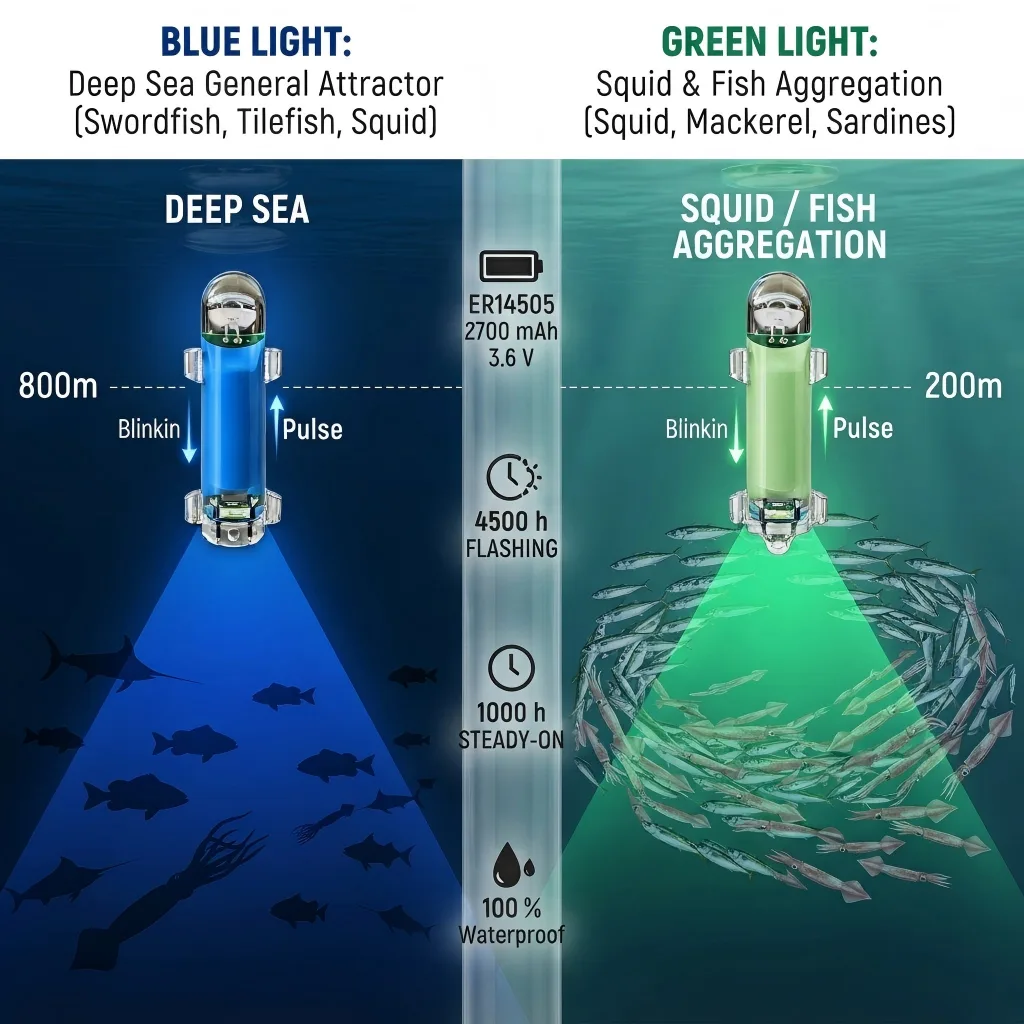
| Factor | Green (~525 nm) | Blue (~465-490 nm) |
|---|---|---|
| Deepest penetration | Coastal / turbid / green water | Clear open-ocean water |
| Documented catch rate (longline) | Highest for swordfish & tuna targets in controlled trials | Significantly lower catch rates in the same trials |
| Industry standard | The classic chemical lightstick color; most-stocked deep drop LED color | Standard second color; common in ultra-deep commercial lights |
| Apparent brightness to the human eye | Peak of human photopic sensitivity (~555 nm) – looks brightest on camera and at night | Looks dimmer than green at equal power |
| Visual ecology | Blue-green sensitivity dominates pelagic fish vision | The only ambient light at extreme depth – many deep-sea retinas are blue-tuned |
| Bycatch consideration | Also attracts sharks & turtles more | Lower bycatch in trials – a selectivity tool |
The verdict. There is no universal winner – there is a water-type winner. For the 500-1,200 ft (150-370 m) deep drop fishery across the US Atlantic and Gulf shelf, green is the proven default: it sits inside the attenuation minimum of green-dominant shelf water, matches the blue-green sensitivity of snapper-grouper complex vision, and carries the strongest experimental evidence behind it. For ultra-deep drops past 400 m in clear oceanic water, or canyon-edge water with high clarity, blue retains more photons per meter and is the better choice. Many commercial crews hedge with alternating blue/green, which is why both colors exist on virtually every serious deep drop light.
Reference: a 2022 longline study comparing green (525 nm), blue (465 nm) and white attractors across 57 fishing sets found green produced the highest target-species catch rates, while blue and white caught significantly fewer fish of both target and bycatch species (Fisheries Research).
3. Color Performance by Depth Zone
| Depth | Zone | What survives | Recommended color |
|---|---|---|---|
| 0-50 m | Inshore / night squid / pier | All colors; white useful for area lighting | White, green, or red (squid) – color choice barely matters here |
| 50-150 m | Shelf edge, reef drop-off | Green, blue, residual white-blue | Green |
| 150-370 m (500-1,200 ft) | The deep drop core zone: tilefish, snowy/yellowedge grouper, blueline, yelloweye | Green + blue only; everything else is gone | Green (turbid) / Blue-Green (clear) |
| 370-600 m (1,200-2,000 ft) | Queen snapper, barrelfish, blackbelly rosefish, warsaw | Green + blue, heavily attenuated | Blue or high-intensity green strobe |
| 600 m+ | Ultra-deep structures | Blue window only, minimal green | Blue, strobe mode to extend battery |
Note the strobe column in the last two rows: at extreme depths your battery budget matters as much as your wavelength. A strobe duty cycle of roughly 25 flashes per minute extends runtime by an order of magnitude versus constant-on – at 600 m you need every photon you can generate, and you need it for the whole drift, not the first twenty minutes.
4. Target Species Matching Table
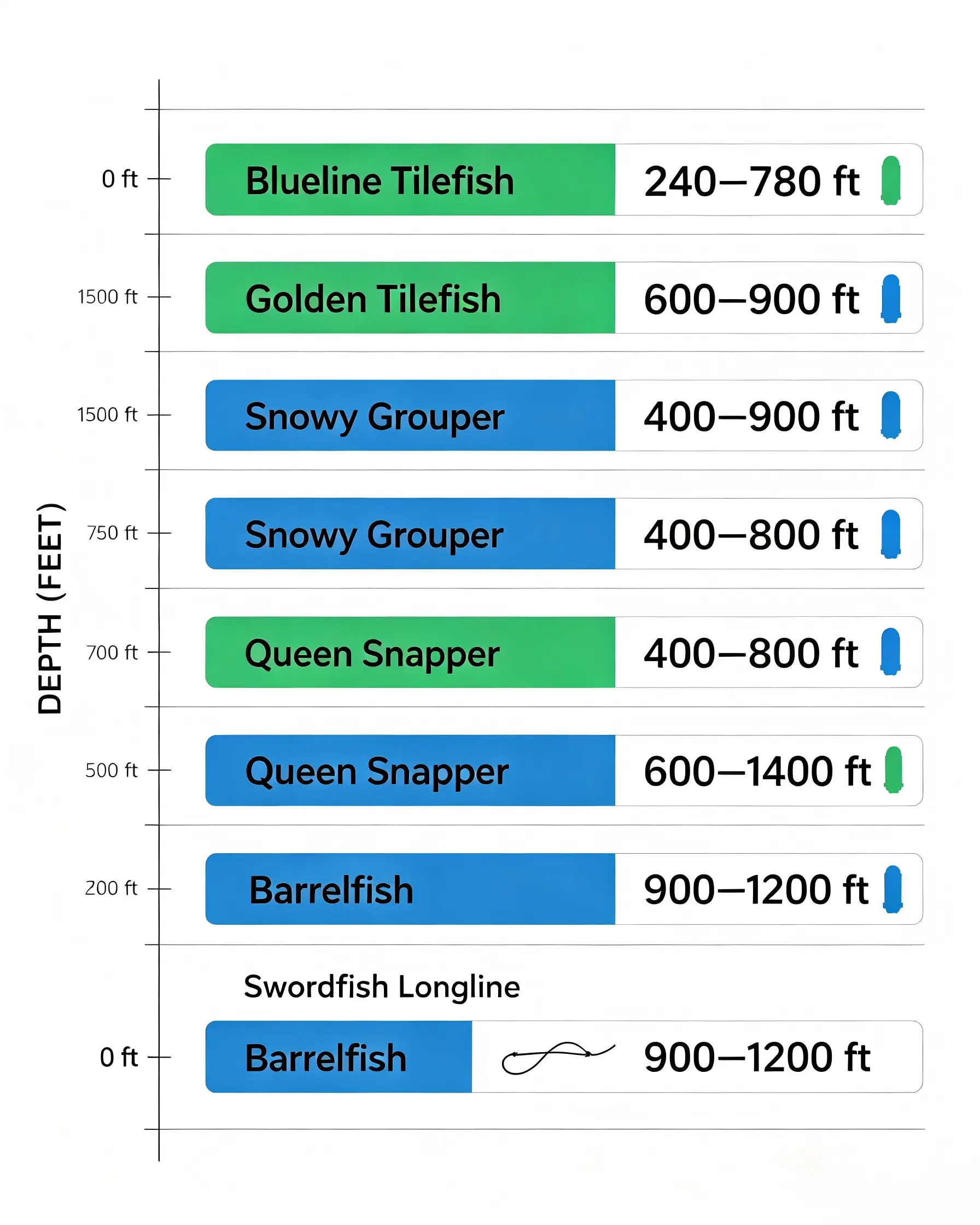
| Target species | Typical depth | Best color | Why |
|---|---|---|---|
| Blueline tilefish | 240-780 ft (75-240 m) | Green | Green-dominant shelf water; aggregating near burrows |
| Golden tilefish | 600-900 ft (180-275 m) | Green / Blue-Green | Mud-bottom plateau edges; water often turbid Gulf stream mix |
| Snowy grouper | 400-800 ft (120-245 m) | Green | Holes & ledges; classic deep drop zone |
| Yellowedge grouper | 400-630 ft (120-190 m) | Green | Humps and ledges |
| Yelloweye (silk) snapper | 250-400 ft (75-120 m) | Green | Shallower end – still well past red/orange range |
| Queen snapper | 600-1,400 ft (180-430 m) | Blue-Green / Blue | Approaching the blue-window transition; deep clear water over trenches |
| Barrelfish | 900-1,200 ft (275-370 m) | Blue-Green | Deep hard bottom; favors the deeper-reaching color |
| Blackbelly rosefish | 800-1,150 ft (245-350 m) | Blue-Green | Same band as barrelfish |
| Swordfish / tuna (longline) | Epipelagic, night sets | Green | Strongest evidence base; green 525 nm lightstick above each bait |
| Wreckfish | 150-300 m+ | Green | Structure-oriented; mid-depth window |
How you attach the light matters as much as which color you choose – placement on the branch line controls whether the beam hangs in the strike zone. Our deep drop light snap hook rigging guide covers three proven attachment setups.
5. The Phototaxis Chain: Why Light Attracts Fish at All
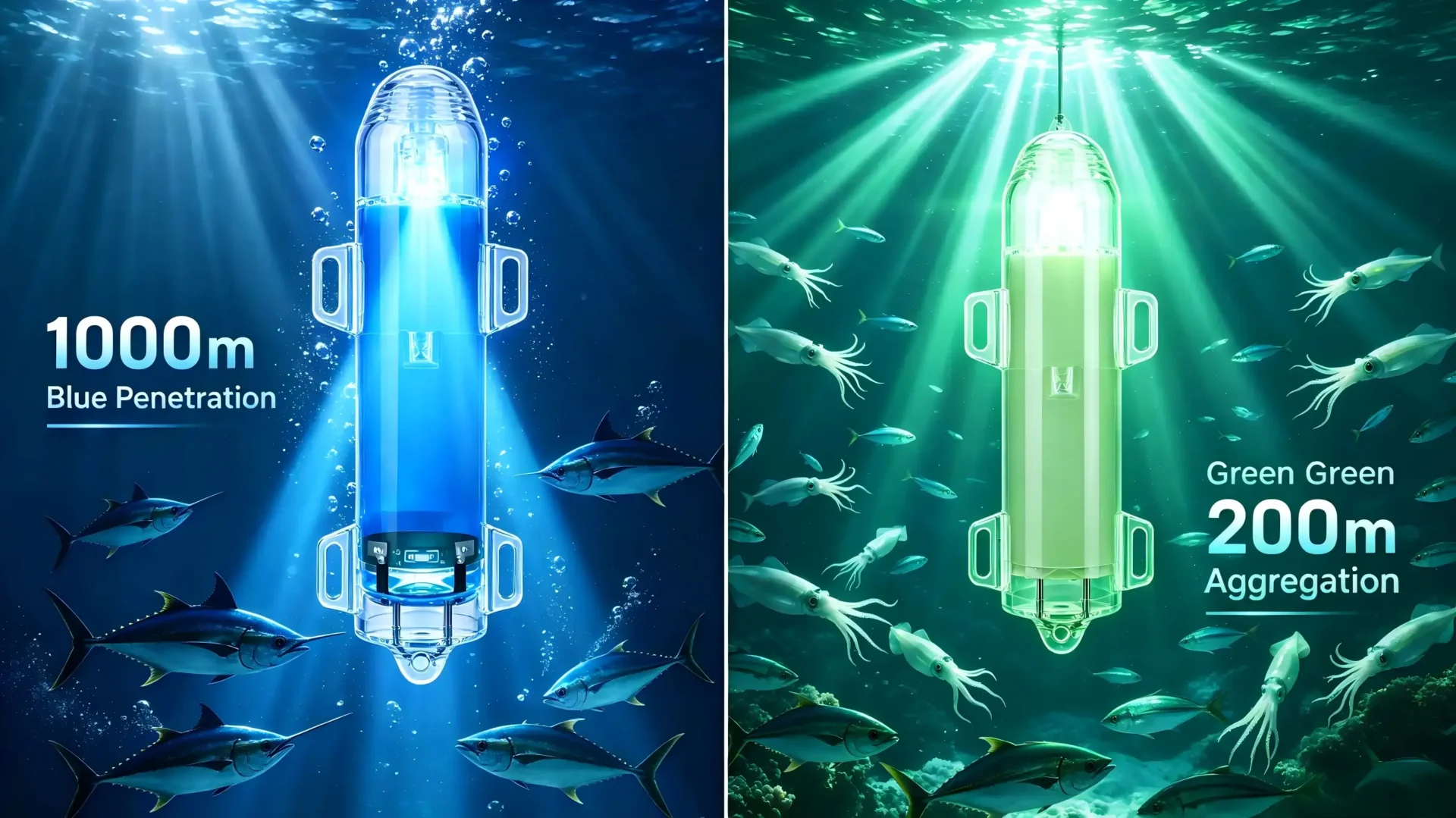
Light does not hypnotize fish – it builds a food chain in miniature. The mechanism, documented across fisheries science:
- Zooplankton and small pelagics aggregate to the light. Many marine organisms perform diel vertical migration – rising from the deep at night to feed – and are strongly attracted to blue-green point sources.
- Baitfish follow the plankton. The light becomes an artificial reef of activity.
- Predators investigate. Tilefish, grouper, snapper and swordfish hold a territory or patrol a depth band; a persistent light source above the bottom is a beacon saying “food is concentrating here.”
There is a second, fascinating layer for swordfish specifically: squid communicate with bioluminescent pulses. Night longliners have long noticed that flashing lights outperform steady lights – a pulsing strobe mimics the distress and signaling light patterns of squid, the swordfish’s primary prey. This is one reason strobe-mode deep drop lights have displaced steady-on lights in the swordfish fishery, and why the “disco” multi-color cycling lights earn their keep despite looking gimmicky: rapid color change reads as biological signaling, not a static lamp. For the full bait-fishing context, see our swordfish longline lighting guide.
6. Where the Other Colors Fit
- White: all wavelengths at once – the red component is absorbed within meters, the blue-green component carries on as a dim residual. Best for docks, piers, attracting squid at night, and illuminating a small area. Inefficient below 100 m at equal battery budget.
- Red: a 5-15 m sphere, invisible beyond it. Useful for squid jigging and shy inshore predators that spook under white light. Irrelevant for deep drop.
- Yellow: performs like a weaker green; occasionally stocked for shallow/coastal use.
- Disco / multi-color cycling: rapid wavelength change mimics bioluminescent signaling; anecdotally strong on swordfish and snapper, pairs naturally with strobe mode. A multi-color LED fishing light gives you the full palette in one body.
7. Putting It to Work
For the commercial operator or charter captain, the decision compresses to three questions:
- How deep? Under 400 ft: green. Over 1,000 ft in clear water: blue or blue-green.
- How clear is the water? Turbid shelf / Gulf outflow: green. Canyon-edge blue water: blue earns its place.
- How long is the drift? Strobe mode multiplies your effective photon budget – at 25 flashes per minute you are running roughly a 5% duty cycle versus constant-on, which is the difference between finishing the drift and reeling in a dead light.
These three questions are also the backbone of our broader guide to choosing the best underwater fishing light – color is one of six selection criteria covered there.
This is exactly the engineering logic behind our deep drop light family. The XC188 deep drop LED fishing light covers the core decision for you: it is stocked in the two wavelengths that physically survive deep water – green for the 150-370 m snapper-grouper zone, blue for ultra-deep clear water – with water activation, strobe and constant modes, and 1,000 m depth-rated housing.
XC193 (coming soon): our next-generation deep drop light – details to be added.
And the economics reinforce the physics: at $1-2 per set versus $30+ for reusable housings, running dedicated green and blue lights on the same drift costs less than a single rigged bait.
FAQ
What color light is best for deep drop fishing?
Green (~525 nm) for the 150-370 m core zone in coastal/green water; blue (~465-490 nm) for ultra-deep clear oceanic water. Everything else is absorbed before it reaches the fish.
Does blue or green light penetrate deeper in seawater?
Blue, in clear oceanic water. Green, in turbid or coastal water. Suspended particles scatter short wavelengths, which is why the “window” shifts from blue toward green as water clarity drops.
What wavelength is a green fishing light and why does it work?
Green fishing lights peak near 525 nm – inside the minimum-absorption window of seawater and near the peak sensitivity of pelagic fish visual pigments. Controlled longline trials found 525 nm green attractors produced the highest target-species catch rates.
Does light color matter for swordfish longline fishing?
Yes – green is the industry standard placed ~1 m above the bait. Note the bycatch trade-off: in trials green also raised shark and turtle captures, while blue caught significantly less of everything, making color a selectivity lever as well as an attraction lever.
Why are red fishing lights sold if red is absorbed so quickly?
Because a 5-15 m sphere of red light is exactly what you want for night squid jigging and spook-prone inshore predators – and exactly what you don’t want below 50 m, where it is invisible.
Is white light good for attracting fish?
White wastes energy: its red/orange components never arrive and its blue-green component is diluted. At equal battery power, a single-wavelength blue or green LED outperforms white below 100 m.