Underwater Green Fishing Lights: A Professional Guide to Deep-Sea and Commercial Fishing Applications
Underwater green fishing lights have become an important lighting option for commercial fishing operations, particularly in squid fishing, deep-drop fishing, longline fishing and night fishing. As fishing fleets face increasing operational costs, deeper fishing grounds and greater demands for equipment reliability, choosing the right underwater LED lighting system is no longer simply about brightness. It is about visibility, operating depth, battery performance, maintenance requirements and suitability for the target fishery.
This guide explains the science behind green underwater lighting, the operational challenges facing modern fishing fleets, and how professional underwater LED fishing lights can help operators select more practical equipment for different fishing environments.
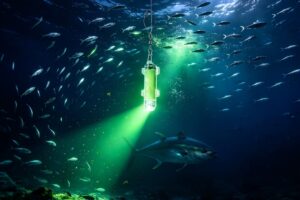
Underwater green fishing lights are submersible LED lighting devices designed to provide controlled green-spectrum illumination below the water surface. Depending on the target species and fishing environment, they can help create a visible light source, influence the movement of light-responsive marine organisms and improve the visibility of baited fishing rigs.
Commercial applications include squid jigging, deep-drop fishing, longline operations, fishing traps and underwater gear marking. The appropriate LED color, light output, depth rating and operating duration should be selected according to the local fishery and deployment conditions.
1. Why Are Underwater Green Fishing Lights Important in Modern Commercial Fisheries?
Commercial fishing has become increasingly demanding. Fishing vessels must operate efficiently while managing fuel consumption, crew time, equipment reliability and changing fishing conditions.
For offshore and deep-water fishing operations, visibility is a particular challenge. Natural sunlight decreases rapidly with depth, and in deep-water environments artificial lighting may be necessary to illuminate fishing equipment and provide visual signals.
Green LED underwater fishing lights are widely considered for these applications because green wavelengths can provide useful visibility in many coastal and marine environments. However, the actual performance depends on water clarity, suspended particles, depth, ambient light and the visual sensitivity of the target species.
The relationship between light and fish behavior
Light-assisted fishing is closely related to phototaxis, the movement of organisms in response to light. In certain fishing environments, plankton and small marine organisms may aggregate around artificial light sources. This can create opportunities for baitfish and predators to approach the illuminated area.
The response is not universal. Different fish and squid species have different visual systems and behavioral responses. Some species respond positively to particular light conditions, while others may show little response or avoid certain illumination levels.
Therefore, successful commercial lighting strategies should be based on species-specific trials rather than assuming that one LED color or brightness level works everywhere.
2. The Real Challenges Facing Commercial Fishing Operators
Challenge 1: Deep-water darkness and limited underwater visibility
One of the biggest challenges in deep-sea fishing is the rapid reduction of natural light with increasing depth. In deeper fishing grounds, sunlight cannot provide sufficient illumination for many operational requirements.
This creates practical difficulties for fishing operations:
- Fishing rigs and bait may have limited visual visibility.
- Artificial illumination must withstand substantial water pressure.
- Light output must remain useful in the actual water conditions.
- Equipment must remain securely attached during deployment and retrieval.
Practical solution: Choose underwater fishing lights according to their verified depth rating, sealing construction, LED arrangement and intended application. A light designed for shallow squid fishing should not automatically be considered suitable for a deep-drop operation.
For operations requiring deeper deployment, the SIKES XC193 Deep Sea LED Underwater Fishing Light offers a compact water-activated design with a customer-tested depth of 1,000 meters and a flashing runtime of up to approximately 4,500 hours.
Challenge 2: Increasing maintenance and crew operating costs
Traditional rechargeable underwater fishing lights can introduce additional work between fishing trips. Crew members may need to retrieve, charge, inspect, clean and reinstall lighting equipment.
Saltwater exposure also creates challenges for electrical connections, switches, battery compartments and seals. Equipment failures can result in additional labor, replacement expenses and interruptions to fishing schedules.
For commercial fleets operating numerous lines or fishing rigs, even a small amount of maintenance per device can become a significant operational consideration.
Practical solution: Evaluate the total operating cost rather than comparing purchase prices alone. Depending on deployment conditions, water-activated disposable lights or replaceable-battery lighting systems can simplify equipment preparation and reduce charging requirements.
For example, the SIKES XC188 series uses automatic water activation, eliminating the need for manual switching during deployment. The XC-688 provides a different solution through its replaceable AA battery design, allowing crews to replace batteries without charging the complete device.
Challenge 3: Battery failure during long fishing operations
Battery performance is another important issue for commercial fishing lights. A device may appear bright during initial testing but become unsuitable if its battery cannot support the required fishing duration.
Fishing operators should consider:
- Continuous lighting versus flashing operation.
- Battery capacity and actual power consumption.
- Expected deployment duration.
- Battery replacement accessibility.
- Temperature and environmental conditions.
Practical solution: Match the battery system to the operating schedule.
For long deployments where charging is inconvenient, disposable water-activated lights may offer a practical alternative. For operators who prefer battery replacement, an AA-powered signal light can provide more flexibility.
The XC-688 is designed around two replaceable AA batteries, with an approximate runtime of 300 hours per battery set. This makes it a different operating option from the sealed disposable XC188 and XC193 models.
Challenge 4: Equipment loss and the growing concern about ghost fishing gear
Lost fishing gear is a serious environmental and economic problem. Abandoned, lost or discarded fishing gear can continue capturing marine animals after it has been separated from its operator. This phenomenon is commonly known as ghost fishing.
The Food and Agriculture Organization of the United Nations (FAO) identifies abandoned, lost or discarded fishing gear as an important issue because of its impacts on fish stocks, marine wildlife, underwater habitats and maritime safety.
For fishing operators, losing equipment can also mean additional replacement costs, lost fishing capacity and more complicated gear management.
Practical solution: Use appropriate gear identification and monitoring procedures, maintain accurate deployment records, inspect attachment points and follow local fishing gear marking requirements.
Underwater fishing signal lights can provide an additional visual reference in suitable applications. However, they should not be confused with dedicated AIS tracking equipment, GPS tracking systems or legally required fishing gear markers.
The SIKES XC-688 Green LED Underwater Fishing Signal Light is designed for underwater illumination and signal applications, including net marking and longline setups.
Learn more about responsible fishing gear management through the FAO Voluntary Guidelines on the Marking of Fishing Gear.
3. Why Choose Green LED Underwater Fishing Lights?
The effectiveness of underwater lighting depends heavily on the interaction between light wavelength and the underwater environment.
Water does not transmit all colors equally. Red wavelengths are generally absorbed more rapidly, while blue and green wavelengths can travel farther under many clear-water conditions. In coastal water, however, suspended particles and dissolved substances can significantly change light transmission.
Understanding green LED wavelength
Green LEDs commonly used in underwater lighting fall within the approximate 500–550 nm spectral region, although the exact wavelength varies by LED specification.
This spectral range can be useful in many commercial fishing applications because it provides a visible underwater light source and overlaps with the sensitivity ranges of various aquatic visual systems.
Green light is frequently evaluated for:
- Commercial squid fishing.
- Night fishing operations.
- Coastal fishing and baitfish aggregation applications.
- Deep-drop fishing rigs.
- Underwater fishing signal applications.
However, green should not be considered universally superior to blue or white. Species, water clarity, ambient light and deployment depth all influence the final selection.
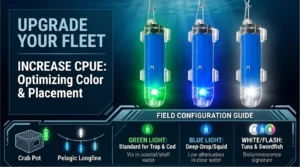
Green vs. blue vs. white underwater fishing lights
| LED Color | Typical Considerations | Potential Applications |
|---|---|---|
| Green | Useful underwater visibility in many coastal conditions | Squid fishing, coastal fishing, deep-drop rigs |
| Blue | Can perform well in clear offshore water | Offshore fishing and species-specific trials |
| White | Broad-spectrum illumination | General underwater lighting and rig visibility |
| Red | Shorter underwater transmission in many marine environments | Specialized applications and controlled trials |
| Yellow | Application-dependent spectral characteristics | Species-specific lighting trials |
The best approach is to test different LED colors under actual fishing conditions and record catch composition, operating depth, water clarity and fishing effort.
4. What Does Scientific Research Say About Green Fishing Lights?
Professional fishing equipment selection should be supported by research rather than marketing claims alone.
A 2025 study published in the International Journal of Design & Nature and Ecodynamics investigated how LED color and intensity influenced fish behavior and shoal distribution during fixed lift-net fishing in coastal waters of Indonesia.
The study compared blue, green, yellow and white LEDs. Under the specific experimental conditions, green illumination produced the highest observed shoal proportion and catch weight.
This is useful evidence that LED color and intensity can influence fish aggregation. However, it should not be interpreted as proof that green lights increase catches in every fishery, species or geographical location.
Another open-access study published in Fisheries Management and Ecology in 2021 examined LED lighting in Finnish inland trap fisheries. Its results did not show an increase in catch per unit effort from LED illumination, demonstrating why field-specific evaluation matters.
These findings support a more scientific approach to underwater fishing lights: select the appropriate spectrum, test the illumination level and evaluate actual operational results.
Read the original research:
- Effects of LED Light Color and Intensity on Fish Behavior and Shoal Distribution for Fixed Lift-Net Fishing (2025)
- The Effect of LED Lights on Trap Catches in Finnish Inland Fisheries (2021)
- FAO: Responsible Fishing Practices and Fishing Gear Marking
5. How to Choose the Right Underwater Green Fishing Light
Choosing a commercial underwater fishing light requires more than selecting a color. Buyers should evaluate the entire system according to the target fishery and deployment conditions.
1. Operating depth and waterproof construction
Depth rating is one of the most important specifications for deep-sea fishing lights. Water pressure increases with depth, placing greater demands on the housing, sealing structure and internal components.
Check the manufacturer’s stated depth rating and the actual testing conditions. IP68 is a waterproof protection classification, but the designation alone does not establish a specific underwater depth rating. Ask for the manufacturer’s documented pressure or depth test.
2. LED arrangement and illumination direction
A single LED and a multi-directional LED configuration serve different purposes. A four-LED arrangement positioned around a compact housing can provide more consistent visibility when the fishing rig changes orientation.
For longline and deep-drop applications, consider how the light is positioned relative to the bait, fishing line and surrounding water.
3. Battery life and lighting mode
Continuous lighting provides constant illumination, while flashing or strobe lighting can extend battery life in some configurations. Compare actual operating hours in the specific mode you intend to use.
4. Attachment and deployment convenience
Fishing lights should be securely attached to the intended fishing rig. Check the attachment holes, loops, clips and material compatibility with your fishing line.
5. Maintenance and total cost of ownership
Consider the cost of charging, battery replacement, equipment retrieval, crew handling and product replacement. The cheapest purchase price does not always represent the lowest operating cost.
6. SIKES Underwater Green Fishing Light Solutions
SIKES develops underwater LED fishing lights for commercial fishing operations, deep-drop applications, squid fishing and marine signal use. Different models address different deployment requirements, from long-duration disposable lights to replaceable-battery underwater signal devices.
XC193 – Deep Sea LED Underwater Fishing Light
Designed for: Deep-drop fishing, longline applications and commercial deep-water operations.
The XC193 is a compact, water-activated disposable underwater fishing light designed for demanding deep-water applications. Its sealed construction and automatic activation reduce the need for manual switching and charging.
- LED colors: Green, blue, white, red and multicolor.
- Waterproof rating: IP68.
- Customer-tested depth: 1,000 meters.
- Battery: Built-in 3.6V ER14505 lithium, 2700mAh.
- Runtime: Up to approximately 4,500 hours flashing.
- Weight: Approximately 56.7g.
- Activation: Automatic water activation.
Operational advantage: A compact, maintenance-free lighting option for fishing operations where charging and equipment handling are inconvenient.
XC188 – Disposable Deep Drop LED Underwater Fishing Light
Designed for: Deep-drop fishing, squid fishing, longline rigs and commercial fishing operations.
The XC188 features four LEDs arranged at the top, bottom and both sides of the housing. This configuration provides approximately 360-degree light distribution, helping maintain visibility when the rig changes orientation underwater.
- LED configuration: Four LEDs with 360-degree distribution.
- Standard LED color: Green.
- Other colors: Blue, white, red, yellow and multicolor, subject to configuration.
- Battery: Built-in 3.7V 3000mAh lithium battery.
- Runtime: Approximately 1,000–1,500 hours solid and 4,000–5,000 hours strobe.
- Waterproof rating: IP68.
- Customer-tested depth: 1,000 meters.
- Activation: Automatic water activation.
Operational advantage: Multi-directional lighting, long operating duration and automatic activation for commercial fishing rigs.
Explore XC188 Disposable Deep Drop LED Fishing Light →
For the alternative XC188 product listing and additional wholesale information, visit: XC188 Deep Drop LED Underwater Fishing Light – Wholesale & OEM.
XC-688 – Green LED Underwater Fishing Signal Light
Designed for: Squid jigging, net marking, longline setups and underwater signal applications.
The XC-688 is designed for operators who prefer replaceable batteries rather than a sealed disposable battery system. Its manual twist switch allows users to select flashing or continuous lighting.
- LED colors: Green, blue, red, white and yellow.
- Lighting modes: Flash and solid.
- Power: Two replaceable 1.5V AA batteries.
- Runtime: Approximately 300 hours per battery set.
- Waterproof rating: IP68.
- Depth rating: 300 meters.
- Housing: Impact-resistant ABS.
- Sealing: Triple silicone ring construction.
Operational advantage: Replaceable AA batteries, manual activation and a practical attachment loop for different fishing applications.
7. Comparing Different SIKES Underwater Fishing Light Models
| Specification | XC193 | XC188 | XC-688 |
|---|---|---|---|
| Product Type | Disposable deep-sea light | Disposable deep-drop light | Fishing signal light |
| LED Arrangement | Single LED configuration | 4 LEDs, 360° | LED signal light |
| Green Option | Yes | Yes | Yes |
| Power Source | Built-in lithium battery | Built-in lithium battery | 2 replaceable AA batteries |
| Operating Mode | Flashing / steady, configuration dependent | Flashing / solid | Flashing / solid |
| Runtime | Up to 4,500h flashing | Up to 5,000h flashing | Approx. 300h |
| Depth Rating | 1,000m customer-tested | 1,000m customer-tested | 300m |
| Activation | Water-activated | Water-activated | Manual twist switch |
| Best Fit | Deep-sea operations | 360° deep-drop visibility | Replaceable-battery signal use |
Note: Specifications are based on the respective product configurations. Actual performance and available options should be confirmed with SIKES before ordering.
8. Why Work with a Professional Underwater Fishing Light Manufacturer?
For importers, wholesalers, marine equipment distributors and commercial fishing suppliers, product reliability is only one part of the purchasing decision. Consistent manufacturing, customization capabilities, quality control and supply stability are equally important.
SIKES (X-COX) Technology Co., Ltd. specializes in underwater LED fishing lights and marine fishing equipment. Our manufacturing and wholesale services support commercial buyers looking for stable product specifications and OEM supply.
Our business capabilities include:
- More than 10 years of manufacturing experience.
- Underwater LED fishing light product development.
- Multiple LED colors and lighting configurations.
- OEM and private-label customization.
- Wholesale and bulk order support.
- Product waterproof testing and quality inspection.
- Export support for international distributors.
For distributors and fishing equipment brands, customized LED colors, product labeling and packaging can help develop a product range suited to specific regional fishing markets.
9. Frequently Asked Questions About Underwater Green Fishing Lights
1. What are underwater green fishing lights used for?
Underwater green fishing lights are used in various light-assisted fishing applications, including squid fishing, deep-drop fishing, longline operations, night fishing and certain trap or pot fisheries. Their main function is to provide underwater illumination and, in suitable environments, influence the behavior of light-responsive marine organisms.
2. Why are green LED fishing lights popular in commercial fishing?
Green LEDs provide useful underwater visibility in many coastal environments, and their wavelength overlaps with the visual sensitivity of various aquatic species. However, the most effective color depends on water clarity, target species, depth and fishing conditions.
3. Are green or blue underwater fishing lights better?
Neither color is universally better. Green is frequently considered for coastal and squid fishing applications, while blue can be useful in clear offshore environments. The best choice should be evaluated through species-specific trials and actual fishing conditions.
4. Can underwater green fishing lights work at 1,000 meters?
Yes, specialized underwater fishing lights can be designed for deep-water deployment. For example, SIKES XC193 and XC188 models have customer-tested depth specifications of 1,000 meters. Always verify the exact model’s depth rating and testing documentation before deployment.
5. What is the difference between disposable and rechargeable underwater fishing lights?
Disposable models use a built-in battery and are designed to operate without charging or battery replacement. Rechargeable models can be reused but require charging and maintenance. Replaceable-battery designs, such as the XC-688, offer another option for operators who want to change standard batteries without charging the complete device.
6. How long do underwater green LED fishing lights last?
Operating duration depends on the battery, LED configuration and lighting mode. SIKES XC193 provides up to approximately 4,500 hours in flashing mode, XC188 offers approximately 4,000–5,000 hours in flashing mode, and XC-688 provides approximately 300 hours per set of two AA batteries.
7. Are IP68 underwater fishing lights suitable for saltwater?
IP68-rated underwater fishing lights are designed for protection against water ingress under specified testing conditions. For saltwater applications, buyers should also consider housing materials, sealing design, corrosion resistance and the manufacturer’s actual pressure-testing procedures.
8. Can underwater fishing lights help reduce fishing operating costs?
They can help simplify certain operating procedures when the selected design reduces charging, switching or maintenance requirements. However, the actual savings depend on purchase price, deployment duration, battery costs, crew time and replacement frequency.
9. Can SIKES customize underwater green fishing lights for wholesale orders?
Yes. SIKES supports wholesale and OEM projects, including available LED colors, product configurations, logos and packaging. Customization requirements and minimum order quantities depend on the selected model.
10. Do underwater green fishing lights guarantee higher catch rates?
No. Artificial light can influence fish and squid behavior, but catch results depend on species, water conditions, fishing gear, light intensity, deployment depth and fishing technique. Scientific studies have reported different outcomes across fisheries. Field testing is recommended before large-scale deployment.
Looking for Reliable Underwater Green Fishing Lights for Your Business?
Whether you supply commercial fishing fleets, operate a deep-sea fishing vessel or distribute marine fishing equipment, SIKES can help you select the right underwater LED fishing light for your application.
Contact our team for product specifications, wholesale pricing, OEM customization and samples.
Get Wholesale Price on WhatsAppEmail: jessiechen002@gmail.com
SIKES – Your Reliable Underwater Fishing Light Manufacturing Partner
10+ Years Manufacturing | OEM & ODM | Wholesale Supply
10. References and Further Reading
For additional technical and industry information, readers can consult the following independent organizations and research publications:
- FAO – Responsible Fishing Practices and Marking of Fishing Gear
- FAO – Abandoned, Lost or Otherwise Discarded Fishing Gear
- OECD – Review of Fisheries: The Challenge of Ghost Fishing Gear
- Scientific Research – Effects of LED Light Color and Intensity on Fish Behavior
- Fisheries Management and Ecology – The Effect of LED Lights on Trap Catches
About SIKES: SIKES (X-COX) Technology Co., Ltd. develops and supplies underwater LED fishing lights, deep-drop fishing lights and marine fishing equipment for international wholesale and OEM customers.