Quick Answer: An underwater fishing light is a sealed, submersible LED lamp that attracts fish by triggering phototaxis — light draws plankton, plankton draw baitfish, baitfish draw predators. For most saltwater applications, green LEDs (520–535nm) penetrate deepest in coastal water, while blue and white perform better offshore. Commercial operators should prioritize 300+ lumens, IP68 sealing, and 100+ hour battery life.
After 10+ years manufacturing deep-drop lights for fleets in 30+ countries, here’s what actually matters — and what most buyers get wrong.
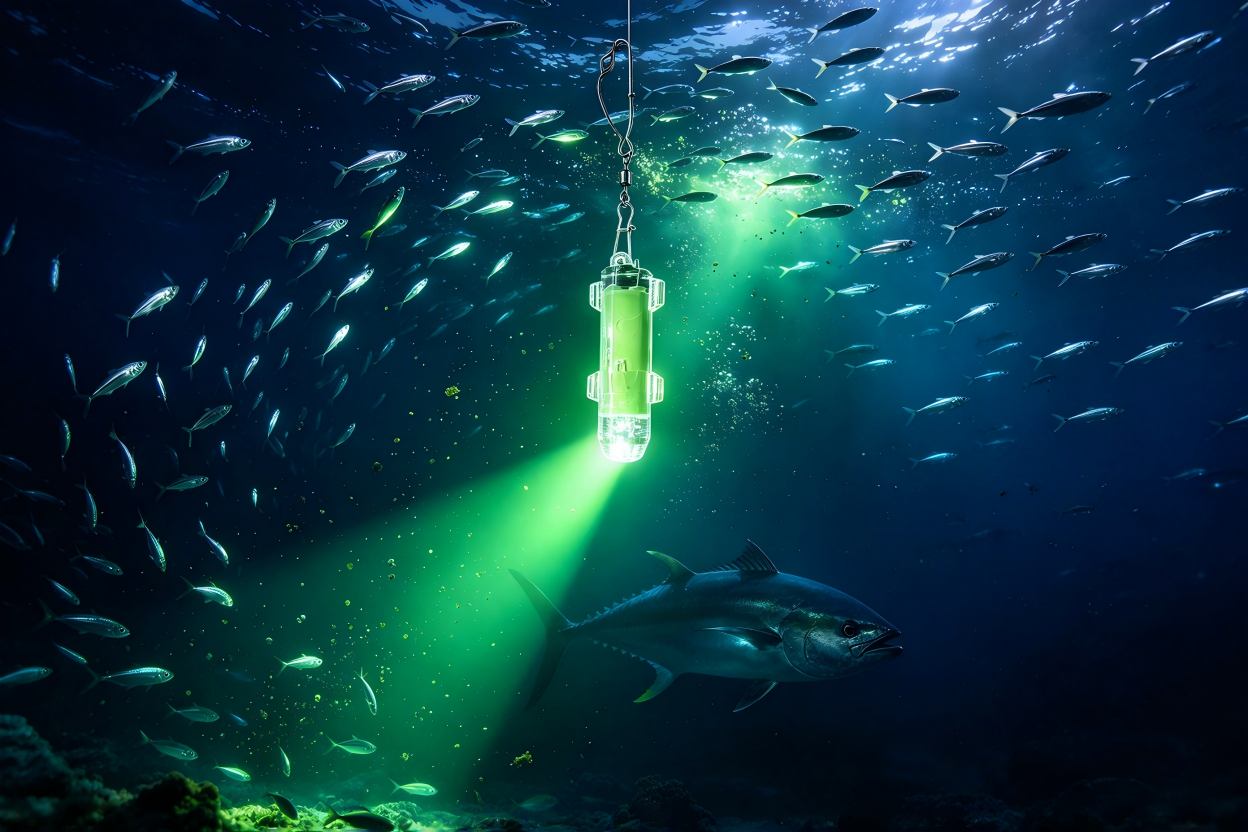
1. How Do Underwater Fishing Lights Attract Fish?
The science is a simple three-step food chain reaction:
- Light triggers plankton aggregation — zooplankton swim toward the light source (positive phototaxis).
- Baitfish arrive to feed on the concentrated plankton.
- Predatory species — tuna, cod, snapper, swordfish — move in to hunt the baitfish.
💬 “You’re not fishing with a light. You’re farming an entire food chain in the water column.”
This is why a quality underwater fishing light consistently outperforms bait alone, especially at night or in deep water.
2. What Color Underwater Fishing Light Works Best?
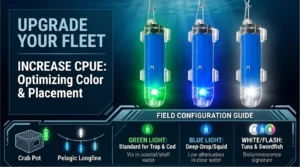
Short answer: Green for inshore/coastal, blue or white for offshore deep water.
| Color | Wavelength | Best For | Why |
|---|---|---|---|
| Green | 520–535 nm | Coastal, estuary, squid, tuna | Longest effective penetration in green-dominant coastal water |
| Blue | 450–470 nm | Offshore, deep drop, swordfish | Travels farthest in clear open-ocean water |
| White | Full spectrum | General use, dirty/fresh water | Brightest perceived output; scatters faster in plankton-rich water |
| Red/UV | 620+ nm | Specialized research | Absorbed quickly; rarely used for attraction |
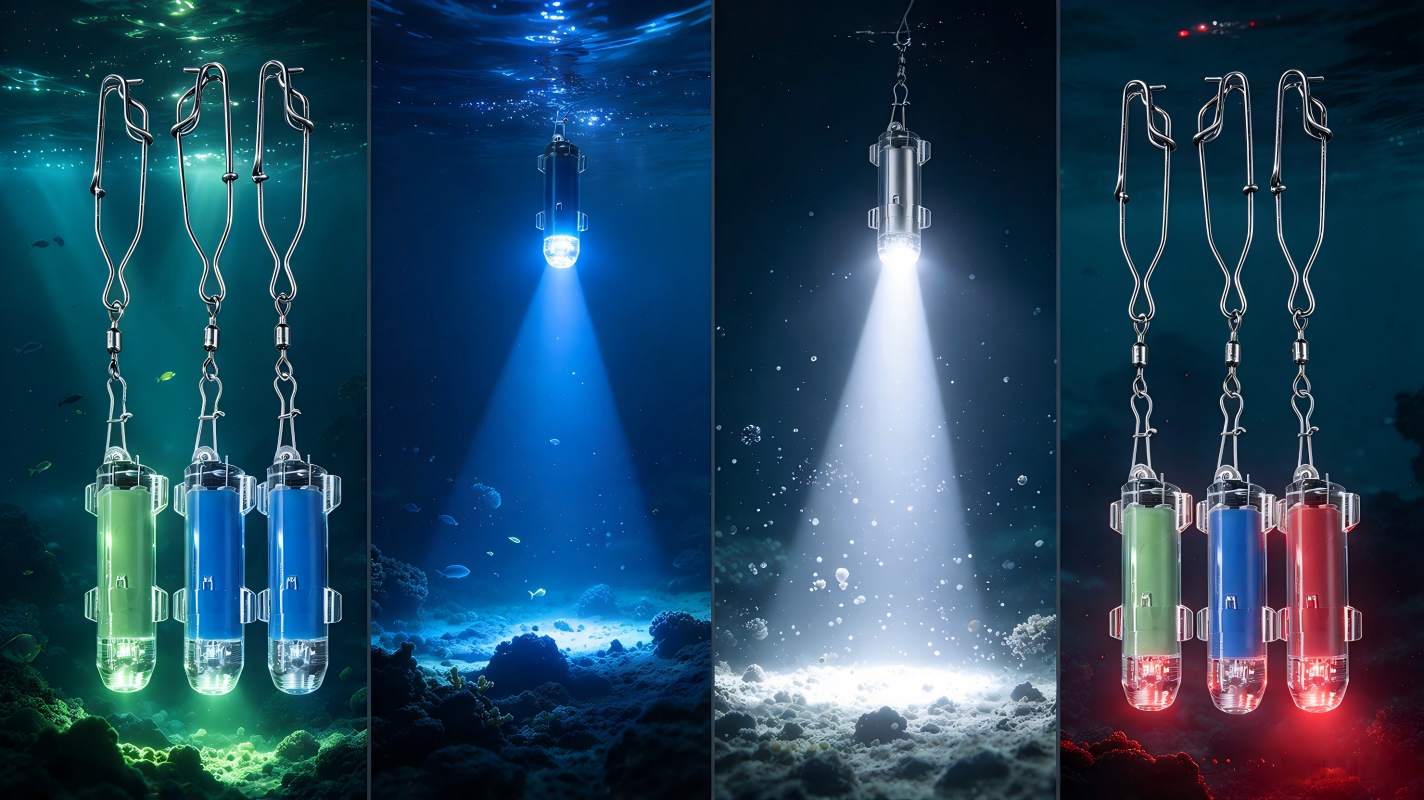
Key buyer insight: Water absorbs red light within the first few meters. Green sits in the spectrum where seawater absorbs least — which is why green became the industry default for squid jigging and coastal fleets worldwide.
3. How Many Lumens Do You Actually Need?
| Fishing Type | Recommended Output | Notes |
|---|---|---|
| Recreational / kayak | 500–1,500 lumens | Single drop light, 10–30m depth |
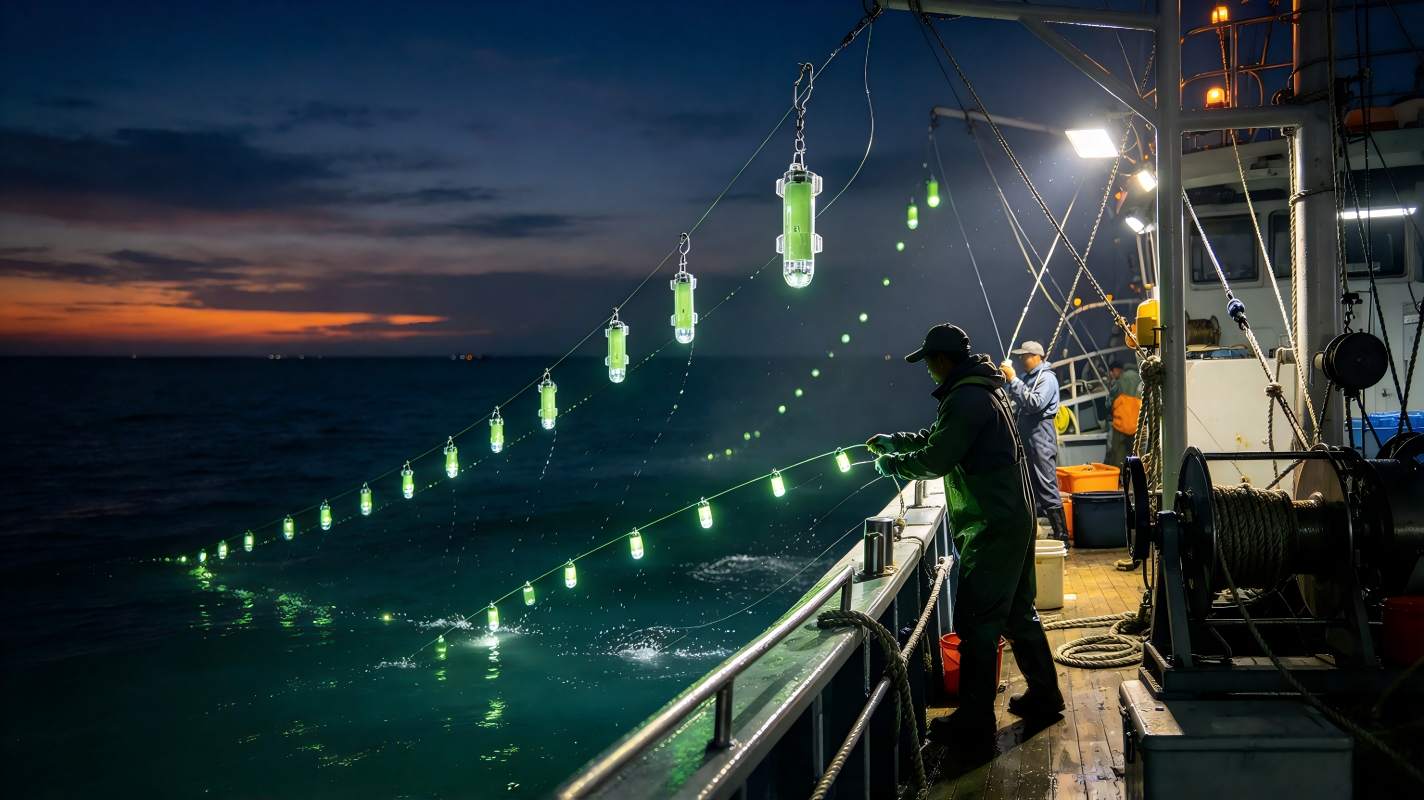
| Squid jigging (commercial) | 3,000–10,000 lumens | Multi-light arrays mimic plankton fields |
| Deep drop (swordfish/tuna) | 1,000–3,000 lumens | Compact, high-pressure rated |
| Longline sets | Modular, per-hook light | Battery life > brightness |
⚠️ Common mistake: Chasing maximum lumens. Beyond a certain threshold, more brightness doesn’t attract more fish — it can spook them. Consistency, color accuracy, and burn time matter more than raw output.
4. LED vs. Halogen vs. Fluorescent: What’s Changed in 2026?
- Halogen: Hot, power-hungry, fragile — being phased out of most commercial fleets.
- Fluorescent: Decent efficiency, but breakable and inconsistent in cold water.
- LED (industry standard): 80–90% less power draw, 50,000+ hour lifespan, shock-resistant, available in precise wavelengths.
The 2026 shift: Fleets are moving from AC-powered deck rigs to self-contained battery LED drop lights — no generator dependency, faster deployment, and lower total cost per fishing day. For short trips and seasonal operations, disposable LED fishing lights offer a zero-maintenance, no-recharge alternative that crews simply clip on and drop.
5. What Specifications Actually Matter? (Commercial Buyer’s Checklist)
When sourcing wholesale, verify these six specs before comparing price:
- Waterproof rating — IP68 minimum; look for depth ratings (100m+ for deep drop).
- Battery life — 100+ hours continuous for longline; replaceable cells are a fleet favorite.
- Lumen-to-watt ratio — efficiency determines real operating cost.
- Impact & pressure resistance — polycarbonate housings survive hauling and stacking.
- Attachment design — swivels and clips must survive 200+ deployments without fatigue.
- Compliance — CE/RoHS for EU import; check local fisheries rules on light fishing.
For multi-day deep water operations, a dedicated deep drop fishing light is built to a different standard than recreational units — pressure housings, depth-rated seals, and deployment-tested connectors.
6. Is Fishing with Underwater Lights Legal?
- Most countries allow light attraction for squid and recreational fishing.
- Some EEZs restrict or ban light-assisted fishing for specific species (e.g., to prevent aggregation of juvenile tuna).
- Longline light marking is increasingly encouraged or required as a bycatch-reduction and gear-visibility measure.
✅ Best practice: Confirm rules with your national fisheries authority before deploying commercial light arrays.
7. How to Deploy an Underwater Fishing Light: 4 Steps
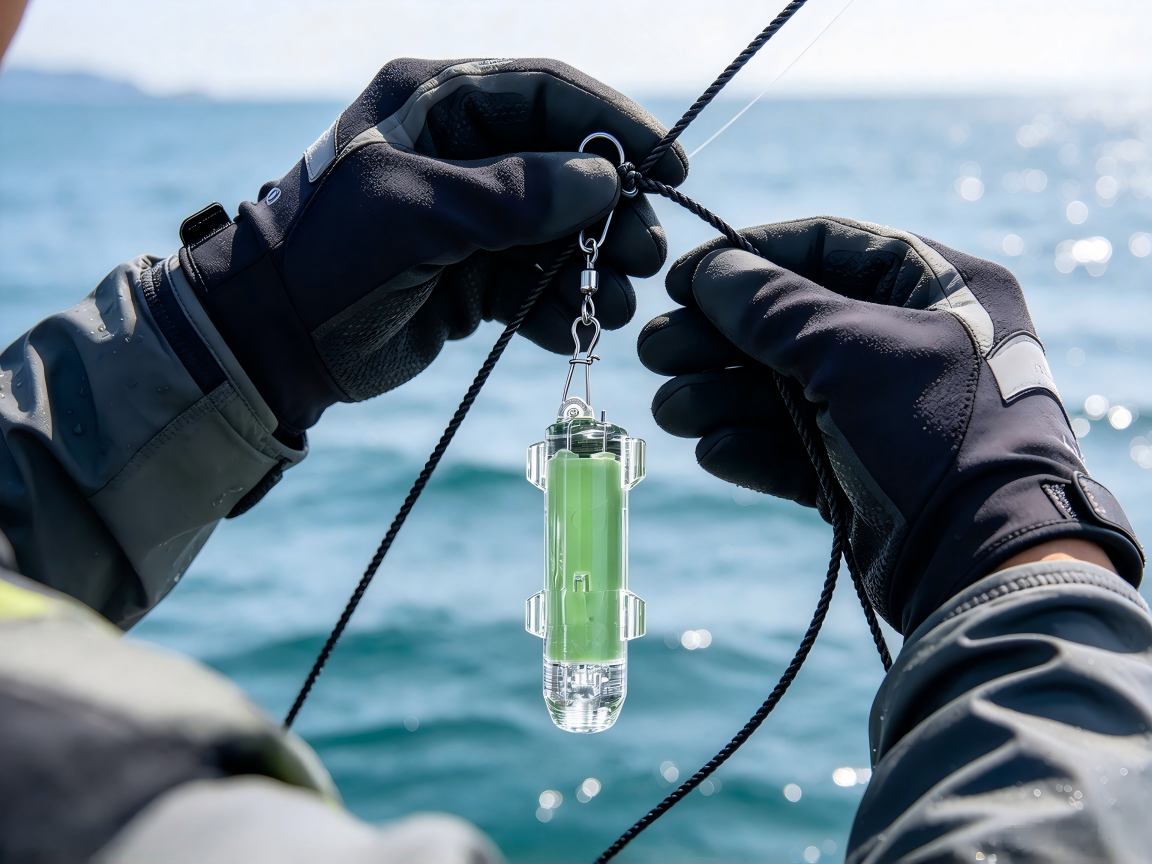
- Clip the light 0.5–1m above your target depth using the swivel connector.
- Lower slowly to avoid line twist and allow the light column to stabilize.
- Wait 15–30 minutes — the food chain needs time to build.
- Fish the edges of the light column, not the center, where predators circle prey.
Frequently Asked Questions
Do underwater fishing lights work in the daytime?
Effectively no — they’re designed for low-light and night conditions. In daylight, use them at depth below the photic zone.
How deep can underwater fishing lights go?
Quality commercial units are rated to 100–500m. Depth rating, not lumen count, is the real limiter for deep drop applications.
Why do squid fleets use green and blue lights?
Squid and their prey exhibit strong phototaxis toward green-blue wavelengths (~500–530nm), which also penetrate squid-fishing depths better than any other color.
What is the lifespan of an LED underwater fishing light?
50,000+ hours for the LEDs themselves. In fleet operation, the battery and connectors are the wear items — choose units with replaceable batteries to maximize ROI.
Can I get underwater fishing lights with custom colors and OEM branding?
Yes — most manufacturers offer wavelength customization and private labeling. Sikes, for example, builds flagship models like the XC188 deep drop LED underwater fishing light factory-direct, with OEM & wholesale programs for distributors and fleet operators.
The Bottom Line
The underwater fishing light market has matured: halogen is out, wavelength-targeted LED is in, and the fleets winning on catch rates are treating light as precision fishing infrastructure — not an accessory. Spec for depth, color, and burn time first; price second.
🎯 Ready to upgrade your fleet’s catch rate?
Sikes manufactures deep drop lights and AIS fishing buoys factory-direct — 10+ years, 500K+ units annually, OEM & wholesale, shipping to 30+ countries.