Commercial Fishing Lights Deployment Guide: Optimizing Light Spectrum, Depth, and Gear Integration
In modern industrial fisheries, phototaxis management has evolved from simple surface illumination into a precision demersal and pelagic harvesting technique. Whether rigging miles of pelagic longlines for broadbill swordfish or deploying heavy pot strings along deep continental shelves, selecting the right commercial fishing lights directly influences catch-per-unit-effort (CPUE), operational efficiency, and operational overhead.
1. Spectrum Penetration & Phototaxis in Industrial Fisheries
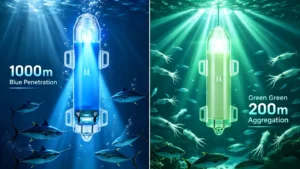
Underwater light transmission is limited by water attenuation, scattering, and target species spectral sensitivity. Selecting between green (520nm) and blue (460nm) wavelengths requires matching light behavior with targeting depths and target physiology.
- Green Wavelengths (~520nm): Offer minimal attenuation in coastal, estuarine, and moderate-depth shelf waters rich in phytoplankton. Green light stimulates primary productivity, attracting copepods, small crustaceans, and baitfish, thereby establishing an active food chain around the gear.
- Blue Wavelengths (~460nm): Experience the lowest attenuation coefficient in clear oceanic waters and deep-sea benthic environments. Blue photons penetrate deeper with minimal energy loss, making them highly visible to deep-water cephalopods, swordfish, and pelagic predators.
For high-volume operations seeking an OEM supply chain partner, sourcing from a dedicated commercial fishing light supplier ensures batch-to-batch wavelength consistency, pressure-rated sealing integrity, and reliable battery discharge rates under extreme hydrostatic conditions.
2. Field Application Scenarios & Gear Configurations
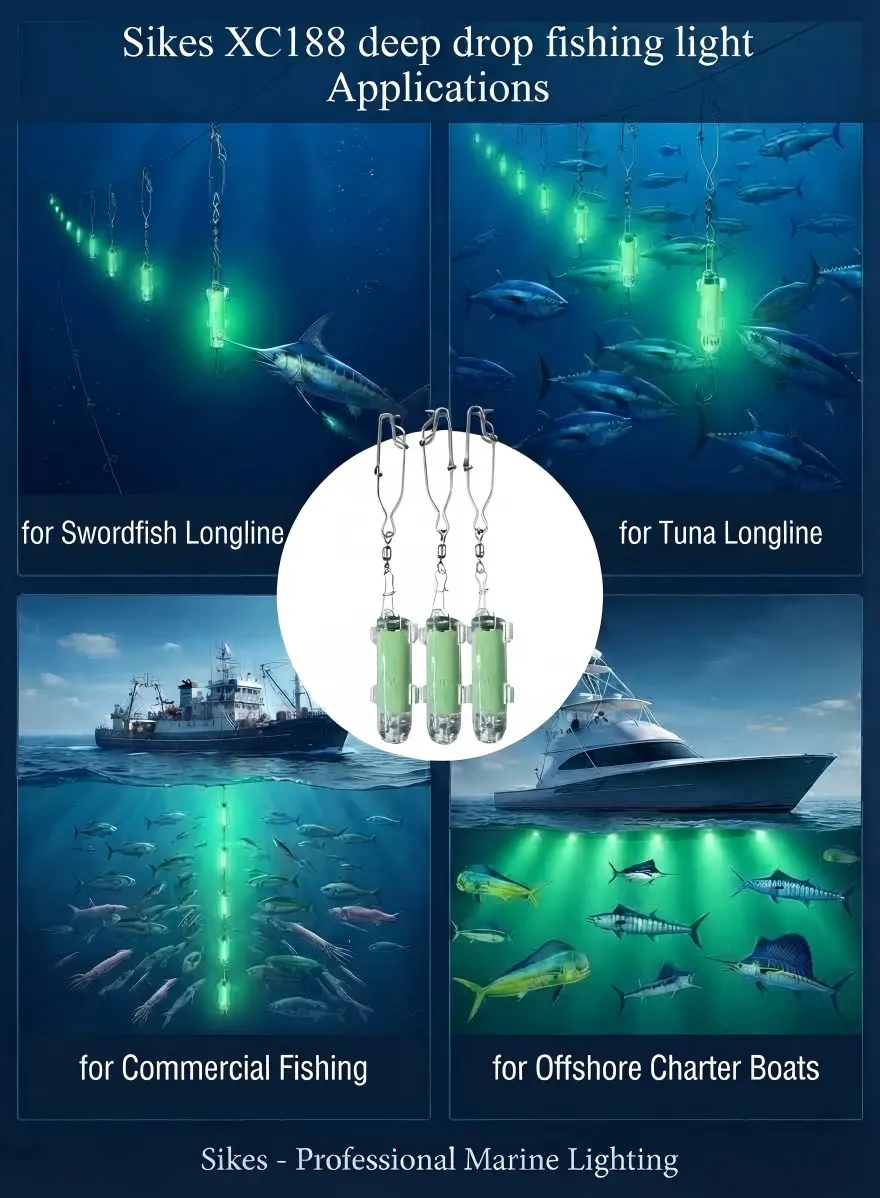
Scenario A: Swordfish Longline & Deep Drop Operations (Underwater Fishing Light for Swordfish Longline & Cod Pots)
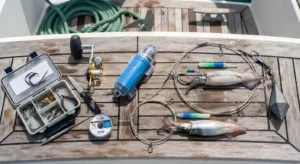
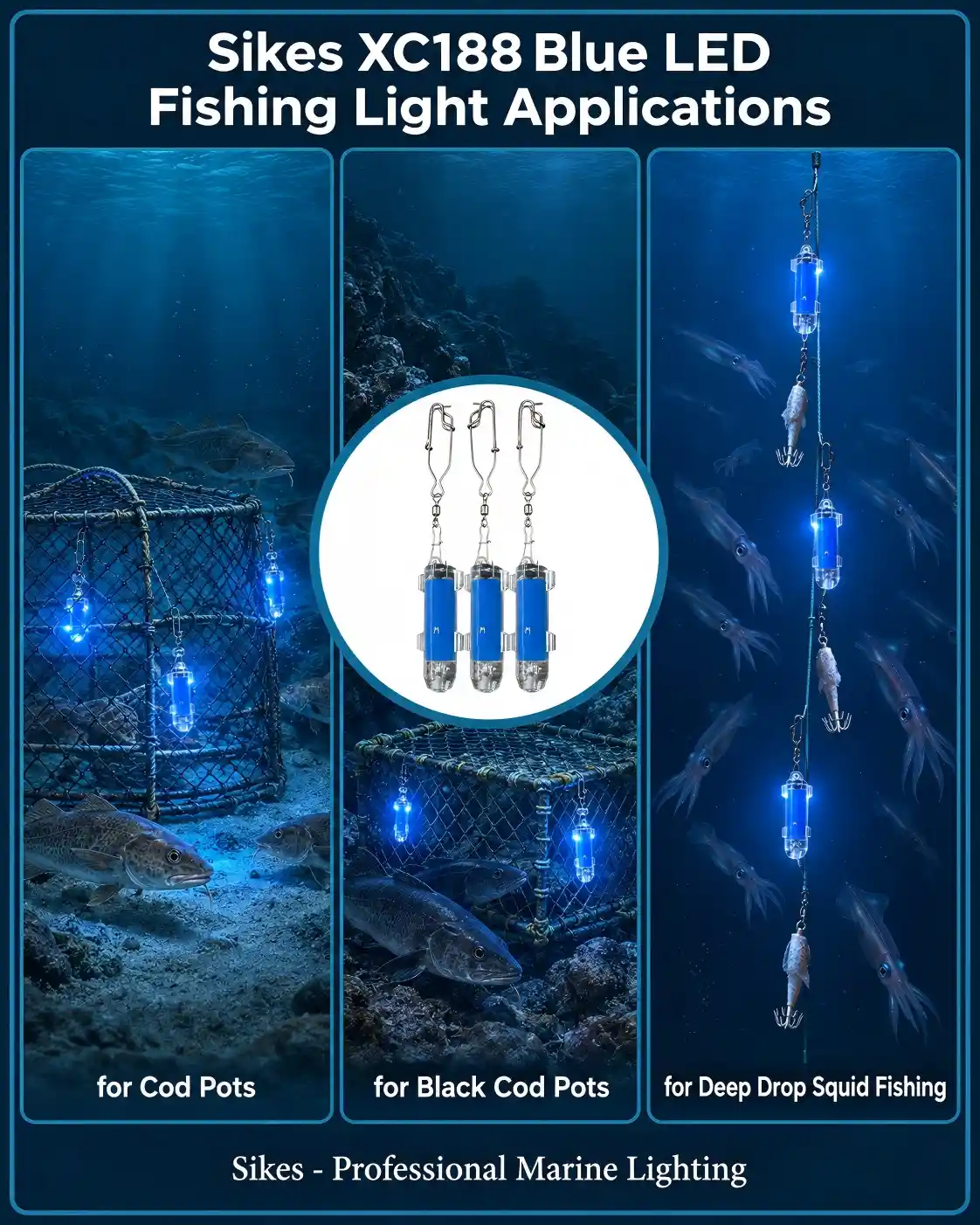
Nighttime pelagic longlining for broadbill swordfish (Xiphias gladius) and deep drop benthic harvesting for black cod demand high hydrostatic pressure tolerance and dependable low-temperature battery life. Placed along branchlines upstream of baited hooks or attached directly to pot frames, underwater lights mimic bioluminescent signals in pitch-black ocean depths.
Testing Protocol: Primary configuration: Green Light. Secondary testing configuration: Blue Light (particularly in deep pelagic offshore zones where blue light maintains superior clarity).
Gear Recommendation: Operators utilizing standard snap-on branchlines benefit from the high-durability Deep Drop LED Underwater Fishing Light XC188. For operations requiring maximum bait proximity and faster deployment speeds, the hook-integrated XC-188 Disposable Deep Drop LED Fishing Light (Hook Integrated) combines point-source illumination with direct hook placement.
Scenario B: Tuna Longline (Fishing Lights for Tuna Longline)
Commercial longliners targeting bigeye and yellowfin tuna utilize light lures on deeper sets along oceanic convergence zones. Strategic light placement along branchlines enhances bait visibility during dawn/dusk transitions and nighttime depth migrations.
Testing Protocol: Green Light standard; Blue Light optional for regional trials in offshore pelagic clear-water fisheries.
Fleet Purchasing: Commercial buyers requiring bulk custom configurations, specialized color outputs, or OEM brand labeling can order direct via wholesale fishing lights and disposable fishing light bulk programs.
Scenario C: Deep Drop Squid Fishing (Deep Drop Fishing Light for Squid Fishing)
Oceanic cephalopods exhibit strong positive phototaxis, relying heavily on ocular sensitivity tuned to shortwave bioluminescence. Deep drop jigging rigs and commercial automated squid reels benefit from high-intensity localized light sources placed along the main leader.
Testing Protocol: Primary configuration: Blue Light (optimal shortwave penetration); Secondary configuration: Green Light / Blue-Green spectrum blends.
Gear Setup: Rigging the pressure-resistant XC188 Deep Drop LED Light above squid jigs increases strike frequency across depth ranges down to 300+ meters.
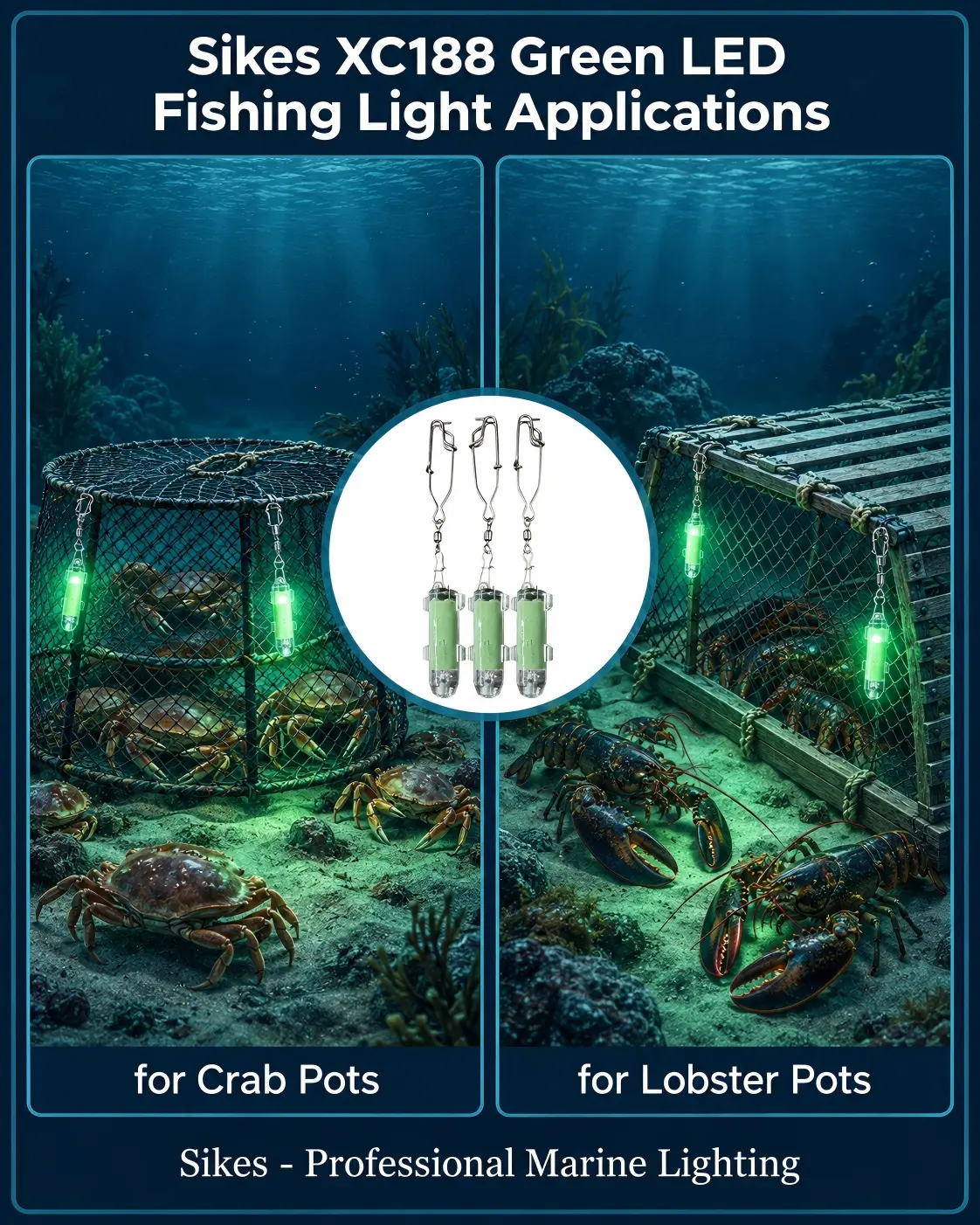
Scenario D: Commercial Trap & Pot Fisheries (Crab, Lobster, & Cod Pots)
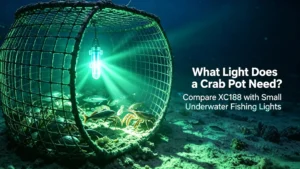
Deploying light sources inside pot frames creates localized bioluminescent points that draw crustaceans and benthic fish through funnel entrances. To establish a reliable inventory strategy, fleet management should categorize lights by functional environment rather than relying on a universal “best color” claim:
| Fishery Type | Primary Standard Config | Secondary Deep/Clear Testing Config | Operational Target |
|---|---|---|---|
| Crab Pots (Underwater Light for Crab Pots) | Green Light (520nm) | Blue Light (460nm) | Visibility in estuarine & coastal shelf waters; attracting foraging amphipods. |
| Lobster Pots (Underwater Light for Lobster Pots) | Green Light (520nm) | Blue Light (460nm) | Default commercial baseline; blue for offshore deep-water canyons. |
| Cod Pots (Fishing Light for Cod Pots) | Green Light (520nm) | Blue Light (460nm) | Comparative trial setup; enhancing ingress rate without startling demersal cod. |
Important Regulatory Notice for Pot & Trap Operators:
Before procuring light gear for large-scale pot deployments, fleet managers and vessel operators must verify local, national, and seasonal fishery regulations regarding light-assisted trapping, pot modifications, and non-target species protection protocols. Permissibility varies across maritime zones.
Scenario E: General Commercial Fishing & Offshore Charter Operations
For general commercial fleets and offshore charter operations (Fishing Lights for Offshore Charter Boats), maintaining a modular inventory ensures readiness across diverse target species:
- Standard Fleet Inventory: Green LED models serve as the default all-around baseline for general commercial harvesting, night charter bottom fishing, and surface bait attraction.
- Optional Deep-Water Configuration: Blue LED units provide dedicated support for deep-drop squid runs, pelagic drift fishing, and ultra-clear offshore waters.
3. Product Selection Guide: Standard vs. Hook-Integrated Disposable Lights
Selecting between standard deep-drop light housings and integrated disposable light units depends on gear assembly workflow, target species, and labor efficiency on deck.
| Feature / Specification | Standard Deep Drop XC188 | Disposable XC-188 (Hook Integrated) |
|---|---|---|
| Product URL | XC188 Standard Deep Drop Page | XC-188 Hook-Integrated Page |
| Design Architecture | Hookless, ultra-sealed housing with dual ring attachments. | Direct-bait hook built seamlessly into the illuminated body. |
| Primary Applications | Crab/Lobster/Cod Pots, Mainline Deep Drop, Squid Rigs. | Pelagic Longlining (Swordfish, Tuna), Rapid Hook Sets. |
| Activation Mechanism | Water-activated / High-pressure sealed power contact. | Water-activated / Self-contained high-output cell. |
| Supply Chain Options | Wholesale fishing lights, OEM casing colors, custom LED options. | Bulk underwater fishing lights, private label fishing gear programs. |
4. OEM, Private Label, & Bulk Wholesale Solutions
As a specialized commercial fishing light supplier, XSIKES offers full OEM and private label manufacturing for commercial distributors, gear outfitters, and regional fishery suppliers worldwide.
- Custom Spectral Engineering: Factory-calibrated monochromatic green (520nm), blue (460nm), deep white, or dual-flash alternating spectrums.
- Pressure & Depth Certification: Precision injection-molded polycarbonate construction engineered to withstand extreme deep-sea pressure regimes.
- Private Label & Packaging: Custom laser marking, branded retail cards, and high-volume commercial bulk packaging tailored for international export.
For custom quotation inquiries, volume pricing tiers, or trial sample shipments, visit our primary product gateways: explore the hookless XC188 Deep Drop LED Underwater Fishing Light for multi-rig operations, or review the XC-188 Disposable Light with Hook for high-efficiency pelagic longline fleets.
Frequently Asked Questions About Commercial Fishing Lights
What color fishing light attracts the most fish?
Green light (around 520nm) is the most effective all-around color for coastal and shelf waters because it attracts plankton and baitfish, building a full food chain around your gear. Blue light (around 460nm) penetrates deepest in clear offshore water and works best for swordfish, tuna, and squid in deep pelagic zones.
How deep can LED fishing lights attract fish?
High-output LED deep drop lights like the XC188 remain effective at 300+ meters. Blue wavelengths maintain the best visibility at extreme depths because they experience the lowest attenuation in clear oceanic water.
Do fishing lights really work for squid?
Yes. Squid and other cephalopods show strong positive phototaxis, especially to shortwave blue light that mimics natural bioluminescence. Rigging a blue LED light above squid jigs measurably increases strike frequency on deep drop and automated jigging setups.
Are fishing lights legal for crab and lobster pots?
Rules vary by region and season. Some fisheries fully permit light-assisted trapping; others restrict pot modifications or light use to protect non-target species. Always verify local, national, and seasonal regulations before deploying lights on commercial pot strings.
Can I get samples before placing a bulk order?
Yes. We provide green and blue XC188 samples so your crew can test both wavelengths on your own grounds before committing. Contact us below for sample pricing and delivery times.
Ready to Test on Your Grounds?
We supply green and blue XC188 samples so your crew can compare both wavelengths on your own fishery before committing to volume. OEM and private label programs available for fleets, distributors and fishing supply brands.
View XC188 Specifications Request Samples & Quote