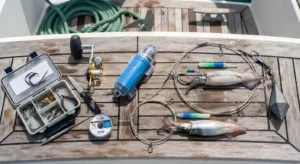
Deep drop fishing is a specialized form of offshore bottom fishing in which a weighted baited rig is lowered into deep water to target species living close to the seabed. It typically requires a high-capacity reel, low-stretch braided line, a strong leader, one or more hooks, a heavy sinker and, in many setups, an underwater fishing light.
What Is Deep Drop Fishing?
Quick answer: Deep drop fishing means presenting bait near the seafloor at depths that are difficult to fish with ordinary bottom-fishing equipment. Depending on the region, conditions and target species, this may begin at approximately 400–600 feet and can extend beyond 1,500 feet. The objective is to keep the bait close to deep-water structure while maintaining enough line control to detect bites and retrieve fish safely.
There is no single universal depth at which conventional bottom fishing becomes deep dropping. FINS Braids describes deep drop fishing as commonly taking place at depths of approximately 400–1,500 feet. Coastal Fishing generally places it beyond 600 feet, while Wahoo Fishing Charters discusses deep dropping at 300 metres and beyond.
The exact working depth matters less than the practical challenge: getting bait to the target zone, controlling the rig in current and recovering it from several hundred metres of water.
How Does Deep Drop Fishing Work?
A deep drop fishing setup uses a sinker to carry one or more baited hooks toward the bottom. The captain first identifies suitable seabed structure with GPS, sonar or a fish finder. The rig is then lowered while the boat is positioned to account for wind, current and drift.
Once the sinker reaches the target depth, the angler keeps the rig close to the bottom without allowing it to drag excessively. Small changes in bottom depth must be followed by raising or lowering the rig. When a bite is detected, steady pressure is used to set the hook and begin the long retrieval.
- Locate deep-water structure with sonar and GPS.
- Choose a sinker that can overcome the current.
- Secure fresh bait to a single-hook or multi-hook rig.
- Lower the rig under control to avoid tangles.
- Confirm bottom contact and lift the sinker slightly.
- Adjust line length as the seabed depth changes.
- Maintain steady pressure when retrieving a hooked fish.
Typical Deep Drop Fishing Depths
| Fishing Zone | Approximate Depth | Typical Considerations |
|---|---|---|
| Deep bottom fishing | 300–600 ft | Strong current, heavy sinkers and high line capacity |
| Common deep drop range | 600–1,500 ft | Electric reels, low-stretch braid and precise depth control |
| Extra-deep applications | More than 1,500 ft | Specialized equipment, careful rigging and experienced vessel operation |
Actual fishing depth should be selected according to the target species, seabed structure, current, vessel capability and local fishing regulations. Anglers should never use depth alone to decide whether an area is safe or legal to fish.
What Fish Can Be Caught by Deep Dropping?
Target species vary greatly by fishing region. Common deep-water targets include:
- Golden and blueline tilefish
- Snowy, Warsaw and other deep-water grouper
- Queen, yelloweye and other deep-water snapper
- Swordfish
- Wreckfish
- Hapuka and blue-eye trevalla
- Sablefish
- Sea bass, perch and other bottom-dwelling species
Not every species is available in every location, and some deep-water fish grow slowly or are subject to strict harvest controls. Always check current size limits, seasons, protected species rules and equipment requirements before fishing.
Essential Deep Drop Fishing Equipment
1. Heavy-Duty Rod
A deep drop rod needs enough backbone to control a heavy sinker and a large fish while retaining sufficient tip sensitivity to indicate bites. Rod selection should match the sinker weight, reel, line class and expected species rather than depth alone.
2. High-Capacity Conventional or Electric Reel
Deep drop reels must hold enough line to reach the bottom while retaining additional capacity for drift and fish movement. Manual conventional reels can be used, but electric reels reduce the physical effort and time required to retrieve a rig from several hundred metres.
An electric reel is especially helpful when anglers need to check bait frequently, reposition the boat or make repeated drops during a fishing session.
3. Low-Stretch Braided Line
Braided line is widely used because its relatively small diameter reduces drag and its low stretch improves contact with the rig. Metered or color-coded braid can also help anglers estimate how much line has been deployed.
The line rating should be selected as part of the complete system, including reel capacity, leader strength, hook size, sinker weight and target fish.
4. Leader, Hooks and Deep Drop Rig
Deep drop fishing rigs may use one hook or several hooks positioned along a heavy monofilament or fluorocarbon leader. Circle hooks are commonly selected because they can promote secure hook placement when steady pressure is applied.
A multi-hook rig presents several baits at slightly different positions above the bottom. However, more hooks can also increase drag and the risk of tangles, so the rig must remain balanced and manageable.
5. Heavy Sinker
The sinker must be heavy enough to carry the rig into the target zone and keep it close to the bottom. The correct weight changes with water depth, current speed, line diameter, bait size and vessel drift.
Using more weight than necessary makes bite detection and retrieval harder. Using too little weight allows the rig to sweep away from the target structure.
6. Deep Drop Fishing Light
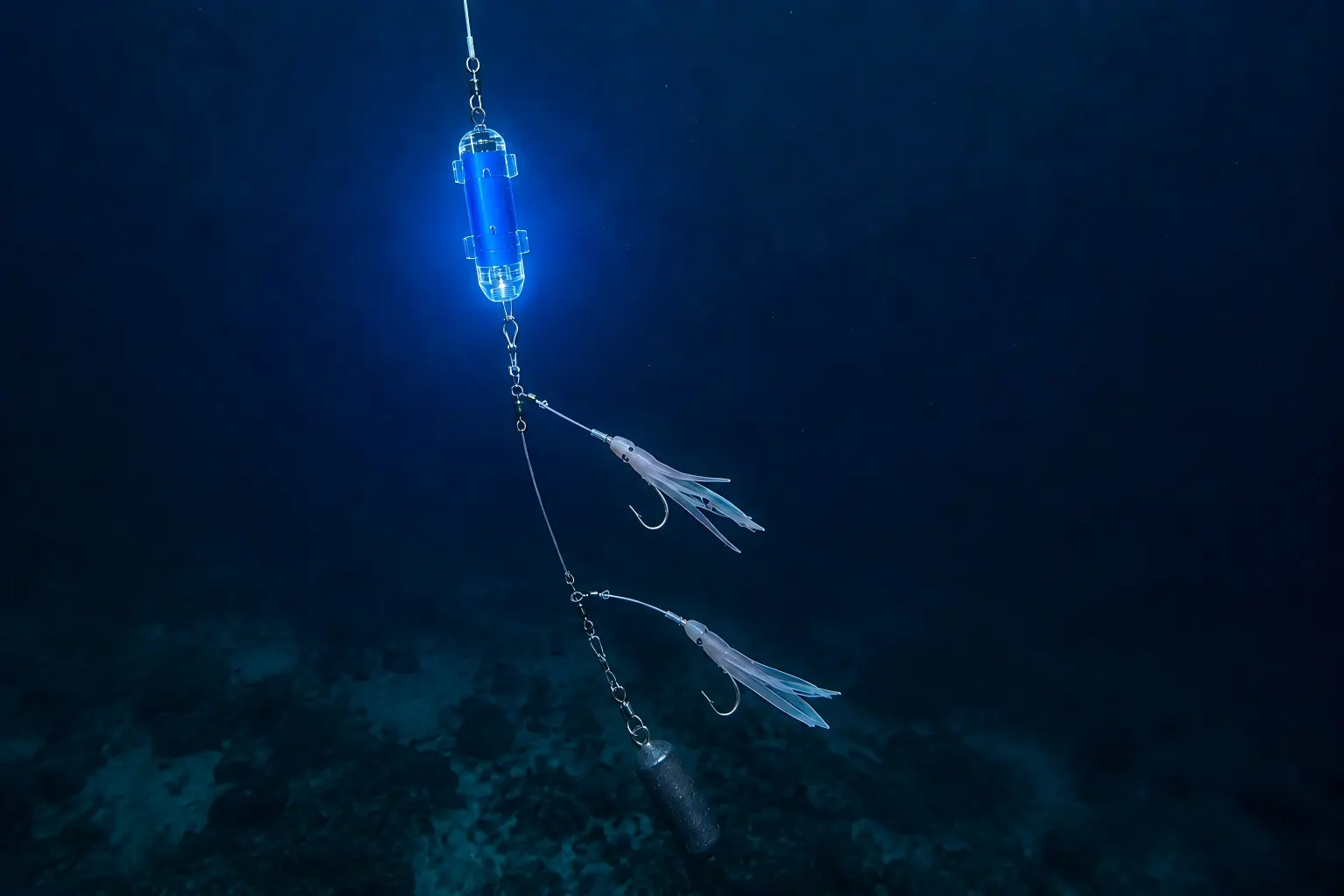
Natural light decreases rapidly with depth. For this reason, glow components and underwater LED lights are frequently added to deep drop fishing rigs to make the bait presentation more visible in dark water.
A compact, water-activated light can be attached above the hooks without requiring an external switch or cable. The XC188 disposable deep-drop LED fishing light is designed for this type of rigging, with automatic water activation, a compact 51 g body and a rated working depth of up to 1,000 metres.
Fishing lights should be considered presentation tools rather than a guarantee of a catch. Their effectiveness can vary according to species, water clarity, fishing depth, current, light color and rig position.
Why Use a Water-Activated Light on a Deep Drop Rig?
A water-activated fishing light turns on when its contact points enter the water and turns off after it is removed and dried. This eliminates the need to find or operate a small switch while preparing multiple hooks on a moving vessel.
For charter operators, commercial fleets and tackle distributors, the main practical benefits can include:
- Faster rig preparation before deployment
- No external battery cable attached to the rig
- Reduced risk of forgetting to switch the light on
- Compact storage with pre-assembled deep drop rigs
- Multiple LED colors for different markets and applications
For detailed configurations, LED color options and wholesale inquiries, buyers can review the dedicated XC188 deep-drop LED underwater fishing light page.
Where Should the Light Be Positioned?
In a typical deep drop fishing setup, the light is installed above the baited hooks rather than below the sinker. This keeps the light close to the bait presentation while reducing the chance of direct contact with the seabed.
A practical arrangement is:
Main line → swivel → leader → underwater light → baited hooks → sinker
The precise position depends on the rig design. The light should not block hook movement, weaken the leader or interfere with the sinker. Every attachment point should be inspected before deployment.
Best Bait for Deep Drop Fishing
Common deep drop baits include squid, bonito, mackerel, mullet, octopus and other oily fish. The best choice depends on local prey and the species being targeted.
Deep drop bait must do more than smell attractive. It also needs to remain on the hook during a long descent through current. Tough strip baits and securely rigged squid are often used because they can withstand water pressure and attacks from smaller fish.
- Tilefish: squid, fish strips and other bottom-oriented baits
- Deep-water grouper: cut fish, squid or larger natural baits
- Snapper: squid, bonito, sardine or local baitfish
- Swordfish: squid, mackerel or carefully rigged natural bait
These are general examples, not universal rules. Local captains and fisheries guidance are usually the best sources for regional bait selection.
How to Prevent Deep Drop Rigs From Tangling
- Lower the rig steadily instead of allowing it to free-fall uncontrollably.
- Keep hook leaders separated and correctly spaced.
- Use enough sinker weight to maintain a controlled descent.
- Avoid excessive slack in the main line.
- Match bait size to the hook and rig.
- Check every swivel, clip and branch line before dropping.
- Use a rig storage system that keeps hooks and leaders separated.
If the current is too strong to maintain bottom contact, adding more weight may not solve the complete problem. Changing the vessel position, line angle or fishing location may produce a safer and more controllable presentation.
Deep Drop Fishing Safety and Responsible Practice
Deep dropping frequently takes place offshore, where changing weather and sea conditions can create significant risk. Check the forecast, vessel systems, communications equipment and emergency gear before departure.
Heavy sinkers and multiple hooks also create hazards on deck. Keep anglers clear of a loaded rod, wear gloves when handling leaders and secure loose hooks before moving the vessel.
Some deep-water fish may experience barotrauma during retrieval. Anglers should understand local release requirements and carry any legally required descending or release equipment. Fishing regulations must always take priority over general equipment advice.
Deep Drop Fishing Setup Checklist
| Item | What to Check |
|---|---|
| Rod and reel | Compatible with sinker weight, line capacity and target species |
| Main line | Correct strength, sufficient capacity and no visible damage |
| Leader | Abrasion resistance, knots, crimps and branch-line spacing |
| Hooks | Sharp points, correct size and legal configuration |
| Sinker | Enough weight for the current without overloading the tackle |
| Bait | Fresh, securely attached and suitable for the target species |
| Fishing light | Secure attachment, correct operating mode and rated depth |
| Electronics | GPS, sonar, fish finder, batteries and saved coordinates |
| Safety gear | Life jackets, communications, first aid and weather information |
Frequently Asked Questions About Deep Drop Fishing
What is considered deep drop fishing?
Deep drop fishing generally refers to bottom fishing in several hundred feet of water using specialized tackle, heavy sinkers and high-capacity reels. The exact starting depth varies by region and target species.
How deep do you fish when deep dropping?
Many deep drops take place between approximately 400 and 1,500 feet, although shallower and deeper applications are possible. Current, seabed structure and species location determine the working depth.
Do you need an electric reel for deep drop fishing?
No, but an electric reel can make repeated retrievals from deep water faster and less physically demanding. A manual conventional reel must have adequate line capacity, gearing and drag performance.
What is the best line for deep drop fishing?
Low-stretch braided line is commonly used because it offers high capacity, reduced water resistance and better contact with the rig. The appropriate line strength depends on the complete setup and target fish.
What is the best bait for deep drop fishing?
Squid, mackerel, bonito, mullet, octopus and fish strips are common choices. The best bait is fresh, securely attached and appropriate for the local target species.
Why are lights used on deep drop fishing rigs?
Underwater lights increase the visibility of the bait presentation in dark deep-water conditions. Results vary by species and environment, so lights should complement—not replace—correct location, bait and rig control.
What color light is best for deep drop fishing?
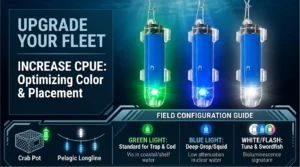
Green, blue, white and red lights are used in different fisheries. There is no universally best color; water clarity, depth, target species and local experience should guide the selection.
Where should a deep drop fishing light be attached?
The light is commonly secured on the leader above the baited hooks. It should be close enough to illuminate the presentation without interfering with hooks, branch lines or the sinker.
Can XC188 be supplied for wholesale or private-label orders?
Yes. Distributors, charter suppliers and commercial fishing buyers can request XC188 bulk quantities, LED color options, packaging details and OEM or private-label services through the product inquiry pages.
Need XC188 Lights for Deep Drop Fishing Rigs?
Contact XSikes for XC188 specifications, samples, LED color options, bulk packaging and OEM/private-label requirements.
View XC188 Product Details Request an XC188 Wholesale Quote